The zodiac has 12 signs. Each sign spans 30 degrees. Divide by twelve and you get a system that places roughly 650 million people — one-twelfth of all humans alive — into the same personality category. The Nakshatra system was designed to solve this problem. Twenty-seven lunar mansions of 13°20' each, further divided into four Padas, produce 108 distinct positions. Your birth Nakshatra places you in 1 of 108 rather than 1 of 12 — and it does so using the Moon, not the Sun, because Vedic astrology has always understood the Moon as the more immediate, personal, and psychologically precise indicator.
This is the complete reference guide. It covers the astronomical structure of the Nakshatra system, the mythology and qualities of all 27 Nakshatras, the Pada sub-divisions, compatibility analysis through the Kuta system, and how Nakshatras connect to the Vimshottari Dasha timing system.
The Astronomical Structure of the Nakshatra System
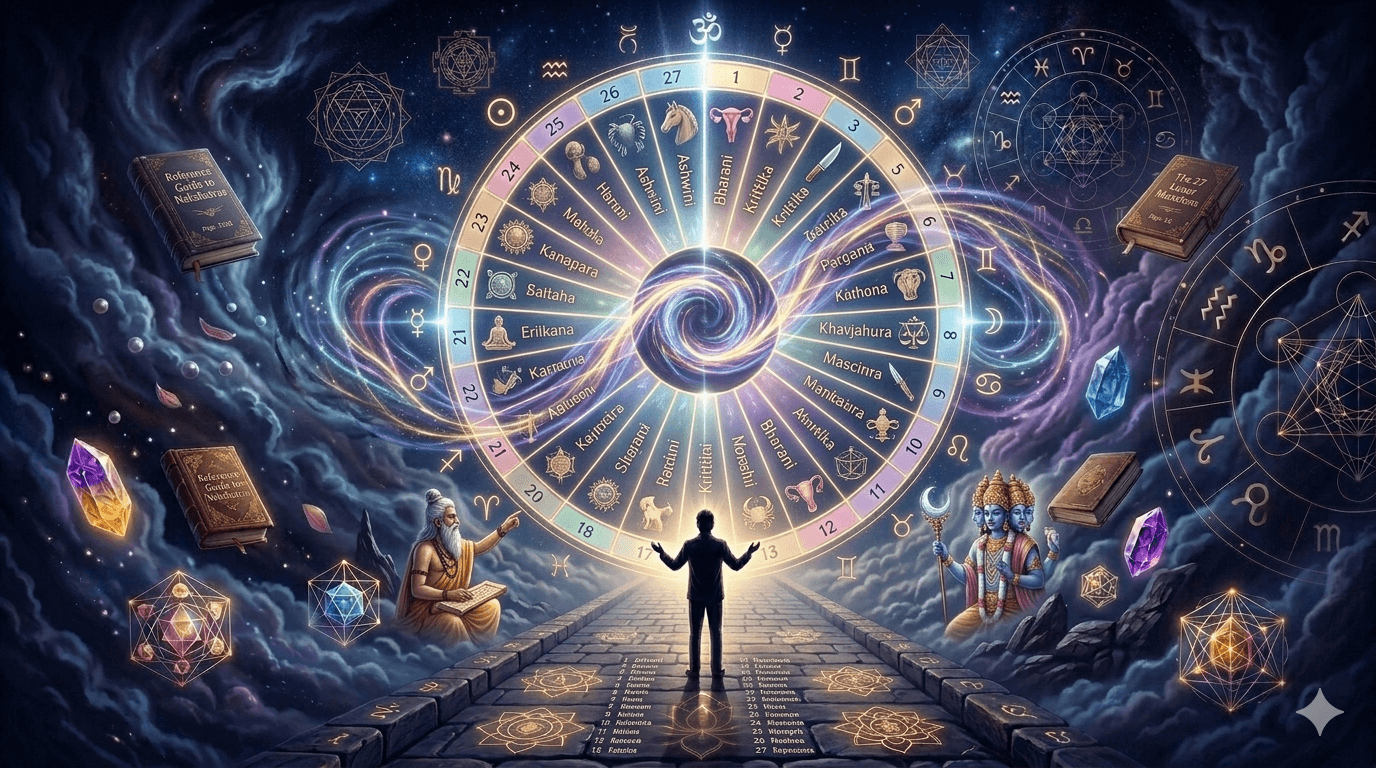
The ecliptic — the apparent path of the Sun through the sky — spans 360°. Vedic astrology divides this into 27 equal segments of 13°20' (13.333...°). These segments are the Nakshatras, and they mark the path the Moon travels as it completes its monthly orbit of Earth.
The Moon moves approximately 13.2° per day, which means it spends roughly one day in each Nakshatra. Over 27 days it traverses all 27 Nakshatras — closely matching the Moon's sidereal period of 27.32 days. This is not coincidence; the Nakshatra system was explicitly designed around the Moon's orbital rhythm.
Each Nakshatra is associated with a specific star or star cluster (the "yogatara" or junction star) that approximately marks its centre. Ashwini is anchored near Beta Arietis, Rohini near Aldebaran, Magha near Regulus, Chitra near Spica, and so on. These are actual fixed stars, which is why the Nakshatra system uses the sidereal zodiac — anchored to the star positions — rather than the tropical zodiac used in Western astrology. For the full explanation of sidereal vs tropical: How Swami Calculates Your Birth Chart.
Each Nakshatra is divided into four Padas (quarters) of 3°20' each. The 27 × 4 = 108 Padas map onto the Navamsa chart in a repeating cycle through the 12 signs, beginning with Aries for Ashwini Pada 1 and ending with Pisces for Revati Pada 4. This Pada-to-Navamsa correspondence is the basis of Navamsa chart calculation — see the full explanation in: Navamsa Chart — The Soul and Marriage Map.
The Three Groups of Nine Nakshatras
The 27 Nakshatras are traditionally divided into three groups of nine, each beginning at 0° Aries, 0° Leo, and 0° Sagittarius respectively. Each group contains the same sequence of planetary rulers (Ketu, Venus, Sun, Moon, Mars, Rahu, Jupiter, Saturn, Mercury) and represents a complete cycle of experience from initiation through completion.
- Group 1 (Aries–Cancer): Ashwini, Bharani, Krittika, Rohini, Mrigashira, Ardra, Punarvasu, Pushya, Ashlesha — the cycle of manifestation and formation
- Group 2 (Leo–Scorpio): Magha, Purva Phalguni, Uttara Phalguni, Hasta, Chitra, Swati, Vishakha, Anuradha, Jyeshtha — the cycle of expression and power
- Group 3 (Sagittarius–Pisces): Mula, Purva Ashadha, Uttara Ashadha, Shravana, Dhanishta, Shatabhisha, Purva Bhadrapada, Uttara Bhadrapada, Revati — the cycle of dissolution and liberation
All 27 Nakshatras — Complete Reference Table
| # | Nakshatra | Span | Ruler | Deity | Symbol | Core Quality |
|---|---|---|---|---|---|---|
| 1 | Ashwini | 0°–13°20' Aries | Ketu | Ashwini Kumaras | Horse's head | Swift healing, new beginnings, pioneering |
| 2 | Bharani | 13°20'–26°40' Aries | Venus | Yama | Yoni | Creative force, restraint, transformation through birth/death |
| 3 | Krittika | 26°40' Aries–10° Taurus | Sun | Agni | Razor/flame | Purification, determination, cutting away the false |
| 4 | Rohini | 10°–23°20' Taurus | Moon | Brahma | Ox cart/chariot | Fertility, sensuality, creative abundance |
| 5 | Mrigashira | 23°20' Taurus–6°40' Gemini | Mars | Soma | Deer's head | Eternal seeking, curiosity, restlessness |
| 6 | Ardra | 6°40'–20° Gemini | Rahu | Rudra | Teardrop | Storm, transformation through destruction, intellectual intensity |
| 7 | Punarvasu | 20° Gemini–3°20' Cancer | Jupiter | Aditi | Bow and quiver | Renewal, optimism, return to the source |
| 8 | Pushya | 3°20'–16°40' Cancer | Saturn | Brihaspati | Flower/circle | Most auspicious Nakshatra — nourishing, spiritually blessed |
| 9 | Ashlesha | 16°40'–30° Cancer | Mercury | Nagas | Coiled serpent | Penetrating perception, mystical wisdom, strategic cunning |
| 10 | Magha | 0°–13°20' Leo | Ketu | Pitrs | Throne room | Regal authority, ancestral connection, lineage |
| 11 | Purva Phalguni | 13°20'–26°40' Leo | Venus | Bhaga | Hammock/front bed legs | Pleasure, creativity, romantic love, generosity |
| 12 | Uttara Phalguni | 26°40' Leo–10° Virgo | Sun | Aryaman | Back bed legs | Service, reliability, extending abundance to others |
| 13 | Hasta | 10°–23°20' Virgo | Moon | Savitar | Hand | Skilled craftsmanship, practical intelligence, dexterity |
| 14 | Chitra | 23°20' Virgo–6°40' Libra | Mars | Tvashtr | Bright jewel | Artistic vision, ambition, luminous beauty |
| 15 | Swati | 6°40'–20° Libra | Rahu | Vayu | Young sprout in wind | Independence, adaptability, diplomatic flexibility |
| 16 | Vishakha | 20° Libra–3°20' Scorpio | Jupiter | Indra and Agni | Triumphal arch | Goal-oriented intensity, purposeful achievement |
| 17 | Anuradha | 3°20'–16°40' Scorpio | Saturn | Mitra | Lotus flower | Devoted friendship, spiritual depth, sociability |
| 18 | Jyeshtha | 16°40'–30° Scorpio | Mercury | Indra | Circular amulet | Elder's authority, protective power, hard-won strength |
| 19 | Mula | 0°–13°20' Sagittarius | Ketu | Nirriti | Tied roots | Root-seeking, uprooting the false, philosophical dissolution |
| 20 | Purva Ashadha | 13°20'–26°40' Sagittarius | Venus | Apas | Fan/winnowing basket | Invincible pride, passionate pursuit, purification |
| 21 | Uttara Ashadha | 26°40' Sagittarius–10° Capricorn | Sun | Vishvadevas | Elephant tusk | Righteous persistence, ethical victory, final triumph |
| 22 | Shravana | 10°–23°20' Capricorn | Moon | Vishnu | Three footprints/ear | Deep listening, learning through tradition, connection |
| 23 | Dhanishta | 23°20' Capricorn–6°40' Aquarius | Mars | Eight Vasus | Drum | Ambitious rhythm, musical intelligence, wealth-building |
| 24 | Shatabhisha | 6°40'–20° Aquarius | Rahu | Varuna | Empty circle | Hidden healing, esoteric knowledge, profound solitude |
| 25 | Purva Bhadrapada | 20° Aquarius–3°20' Pisces | Jupiter | Ajaikapada | Front funeral cot legs | Radical idealism, renunciation for higher purpose |
| 26 | Uttara Bhadrapada | 3°20'–16°40' Pisces | Saturn | Ahirbudhnya | Back funeral cot legs/twin snakes | Ancient wisdom, oceanic depth, patient spirituality |
| 27 | Revati | 16°40'–30° Pisces | Mercury | Pushan | Fish/drum | Boundless compassion, cosmic completion, nourishing guidance |
Nakshatra Rulers and the Dasha Sequence
The ruling planet of your birth Nakshatra determines which Mahadasha (planetary major period) you were born into and initiates the Vimshottari Dasha sequence that governs the timing of your entire life. The nine planetary rulers and their Dasha durations are: Ketu (7 years), Venus (20), Sun (6), Moon (10), Mars (7), Rahu (18), Jupiter (16), Saturn (19), Mercury (17) — totalling 120 years.
Every three consecutive Nakshatras share the same ruler in the same order. Ashwini, Magha, and Mula are all ruled by Ketu. Bharani, Purva Phalguni, and Purva Ashadha are all ruled by Venus. This repeating structure is what makes the 27-Nakshatra system divisible into the 9-planet Dasha cycle. For the complete explanation of how your Nakshatra position determines your Dasha balance at birth — including the actual calculation — read: How Swami Calculates Your Birth Chart. To find your current Dasha period: Dasha Period Calculator.
The Four Padas — The Sub-Division System
Each Nakshatra is divided into four Padas of 3°20' each. The Padas cycle through the four signs of the same quality as the Nakshatra's starting sign — the first Pada corresponds to Aries, the second to Taurus, the third to Gemini, the fourth to Cancer for the first group; Leo, Virgo, Libra, Scorpio for the second group; Sagittarius, Capricorn, Aquarius, Pisces for the third group.
This Pada-to-sign correspondence defines the Navamsa chart position. A planet in Ashwini Pada 1 is in Aries in the Navamsa. A planet in Ashwini Pada 3 is in Gemini in the Navamsa. When a planet occupies the same sign in both the birth chart (D1) and the Navamsa (D9), it is called Vargottama — a position of significant strength and clarity. For a full treatment of Navamsa chart reading: Navamsa Chart — The Soul and Marriage Map.
Nakshatra Compatibility — The Kuta System
Traditional Vedic marriage compatibility (Kundali Milan) is assessed almost entirely through Nakshatra comparison using the Ashtakuta system — eight categories of compatibility scored from two birth Nakshatras. The maximum score is 36 points. The eight Kutas and their maximum scores are:
| Kuta | Max Points | What It Assesses |
|---|---|---|
| Varna Kuta | 1 | Spiritual compatibility and psychological alignment |
| Vashya Kuta | 2 | Natural dominance, attraction, and mutual influence |
| Tara Kuta | 3 | Destiny alignment and health compatibility |
| Yoni Kuta | 4 | Sexual and instinctual compatibility (animal symbol matching) |
| Graha Maitri | 5 | Mental and intellectual compatibility (Nakshatra rulers) |
| Gana Kuta | 6 | Temperament matching: Deva/Manushya/Rakshasa nature |
| Bhakoot Kuta | 7 | Emotional and financial compatibility |
| Nadi Kuta | 8 | Genetic compatibility (most important — same Nadi scores zero) |
Each Nakshatra belongs to one of three Ganas (temperaments): Deva (divine — refined, spiritual), Manushya (human — balanced), or Rakshasa (demonic — intense, powerful). Deva-Deva and Manushya-Manushya pairings score maximum Gana Kuta. Deva-Rakshasa pairings score zero, indicating significant temperament friction. Each Nakshatra also belongs to one of three Nadis (energy channels): Vata (air), Pitta (fire), or Kapha (water). Same-Nadi pairings score zero on Nadi Kuta — traditionally the most important indicator.
To calculate your Nakshatra compatibility with a partner, use the Compatibility Calculator — which runs the full Ashtakuta analysis alongside Western synastry for a complete dual-system compatibility reading.
Nakshatra vs Sun Sign — Why Precision Matters
The Moon completes its Nakshatra cycle in 27.32 days, spending roughly 24 hours in each Nakshatra. Two people born on the same day but in different cities — or even different hours — can have different birth Nakshatras. Two people born three days apart almost certainly do. This is a level of astrological specificity that the monthly Sun sign cycle cannot approach.
The deeper reason Nakshatras are considered more personally accurate is that they track the Moon — the most immediate and intimate planet in the chart. The Moon governs your instincts, your emotional responses, your subconscious patterns, and your earliest formation. The Nakshatra is describing your inner world at a granular level that the Sun sign, which changes only once a month, cannot match. For the full explanation: What Is a Nakshatra and Why It's More Accurate Than Your Sun Sign.
Find your birth Nakshatra, Pada, ruling planet, and Dasha balance with the Nakshatra Calculator. For your complete Vedic chart including all Nakshatra details alongside your Western chart: Birth Chart Calculator.