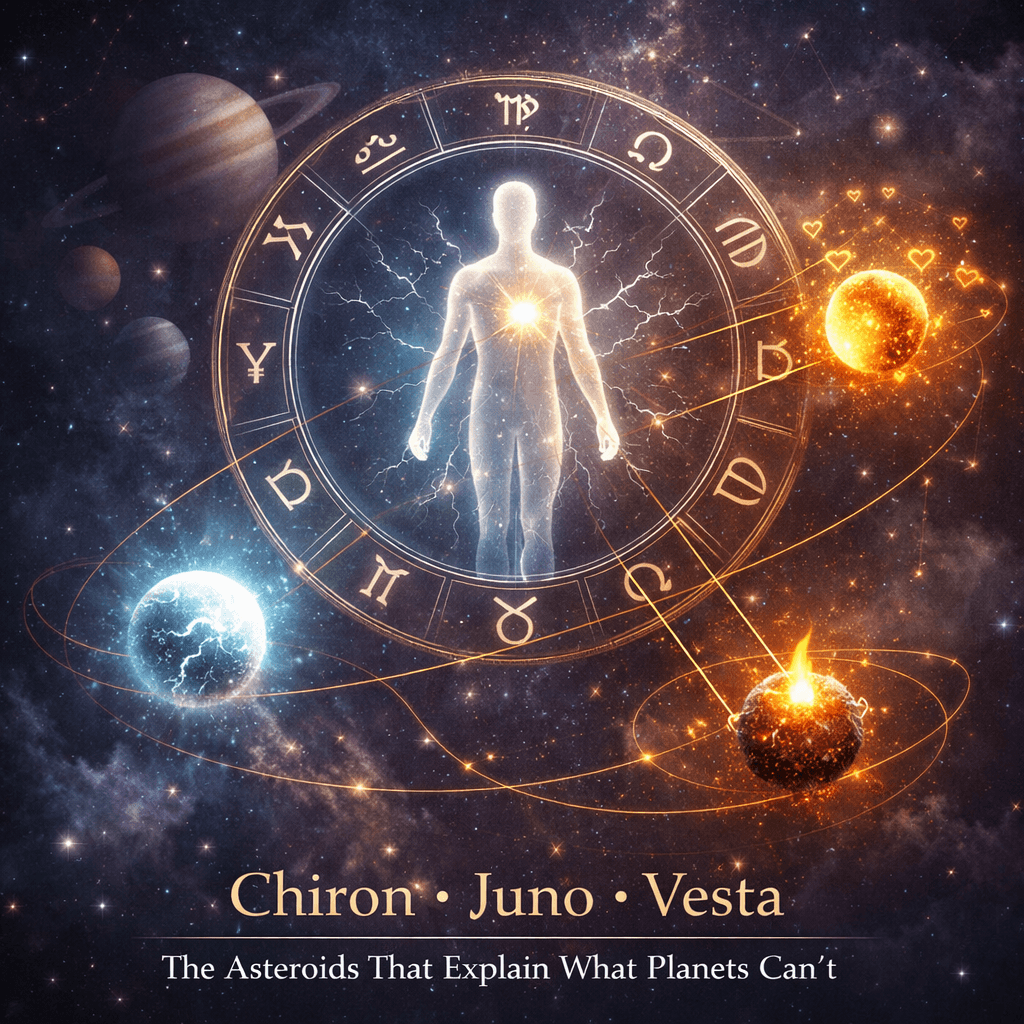
Serious astrologers use asteroids because the ten traditional planets don't cover everything. There are gaps — areas of human experience that the planets gesture toward but don't fully describe. The six major asteroids were each named for mythological figures, and each one governs something specific that no planet quite captures on its own.
The asteroids add a layer of precision to chart reading that the ten planets can't provide on their own. They're the difference between a sketch and a detailed portrait. See all your placements — planets, points, and asteroids — in your free birth chart.
⚷ Chiron — The Wound That Becomes the Gift
Chiron is called the Wounded Healer, named for the centaur in Greek mythology who could heal others but could not heal his own wound. In your chart, Chiron's placement shows your deepest point of pain — often something you've carried since childhood, a place where you feel fundamentally broken or not enough. The paradox is that this wound, when worked with rather than buried, becomes your greatest area of insight and eventually your capacity to help others. Many healers, therapists, and teachers have prominent Chiron placements. The sign and house of your Chiron tells you the nature and arena of the wound. → Find your Chiron placement⚳ Ceres — Nurturing, Nourishment and Grief
Ceres is the largest asteroid in the belt and was briefly reclassified as a dwarf planet. Named for the Roman goddess of the harvest, it governs nurturing — both how you were nurtured and how you nurture others. It also rules food, the body, grief, and the cycles of loss and return (rooted in the myth of Persephone's abduction). Ceres in your chart shows your relationship with nourishment in its broadest sense: physical, emotional, and spiritual. A challenged Ceres can show up as difficulty receiving care or as patterns of abandonment and reunion. → Find your Ceres placement⚵ Juno — Commitment and Partnership
Juno was the Roman goddess of marriage and is the asteroid most associated with committed partnership — not casual attraction (that's Venus and Mars) but long-term commitment: what you need from a partner to stay, what you're willing to invest in, and the dynamic you create within a serious relationship. Juno placements often describe the qualities of a significant spouse or partner. A Juno in Scorpio needs depth and total honesty in commitment; a Juno in Gemini needs intellectual connection and freedom. Understanding your Juno is particularly useful if you find yourself in the same relationship dynamic repeatedly. → Find your Juno placement⚴ Pallas — Wisdom, Strategy and Pattern Recognition
Pallas Athene was the Greek goddess of wisdom and strategic warfare — not brute force but intelligent, planned action. In the chart, Pallas governs pattern recognition, strategic thinking, creative intelligence, and the ability to see the whole picture at once. It's associated with the kind of wisdom that comes from integration rather than accumulation of facts. Strong Pallas placements appear in charts of people who are natural strategists, artists who work with complex structures, or anyone whose intelligence operates more holistically than linearly. → Find your Pallas placement⚶ Vesta — Devotion and Sacred Focus
Vesta was the Roman goddess of the sacred flame — the Vestal Virgins were her priestesses, tending a fire that was never allowed to go out. In the chart, Vesta governs devotion, focused dedication, and the things you're willing to sacrifice other things for. A prominent Vesta placement often appears in the charts of people with a strong calling or vocation — people for whom work is sacred rather than merely functional. It can also show up as a pattern of periodic withdrawal and renewal, needing to retreat to tend your own flame before re-engaging with the world. → Find your Vesta placement⚷ Pholus — The Catalyst and Unstoppable Chains
Pholus is the least well-known of the six but one of the most striking in practice. Named for a centaur who accidentally uncorked a jar of wine that caused catastrophic events, Pholus governs chain reactions — small actions that trigger disproportionately large consequences. It's associated with intergenerational patterns, inherited substances or behaviours, and the moments when something that was contained is suddenly released. Pholus transits and natal placements often correlate with events that feel like they opened a door that cannot be closed again. → Find your Pholus placementThe asteroids add a layer of precision to chart reading that the ten planets can't provide on their own. They're the difference between a sketch and a detailed portrait. See all your placements — planets, points, and asteroids — in your free birth chart.