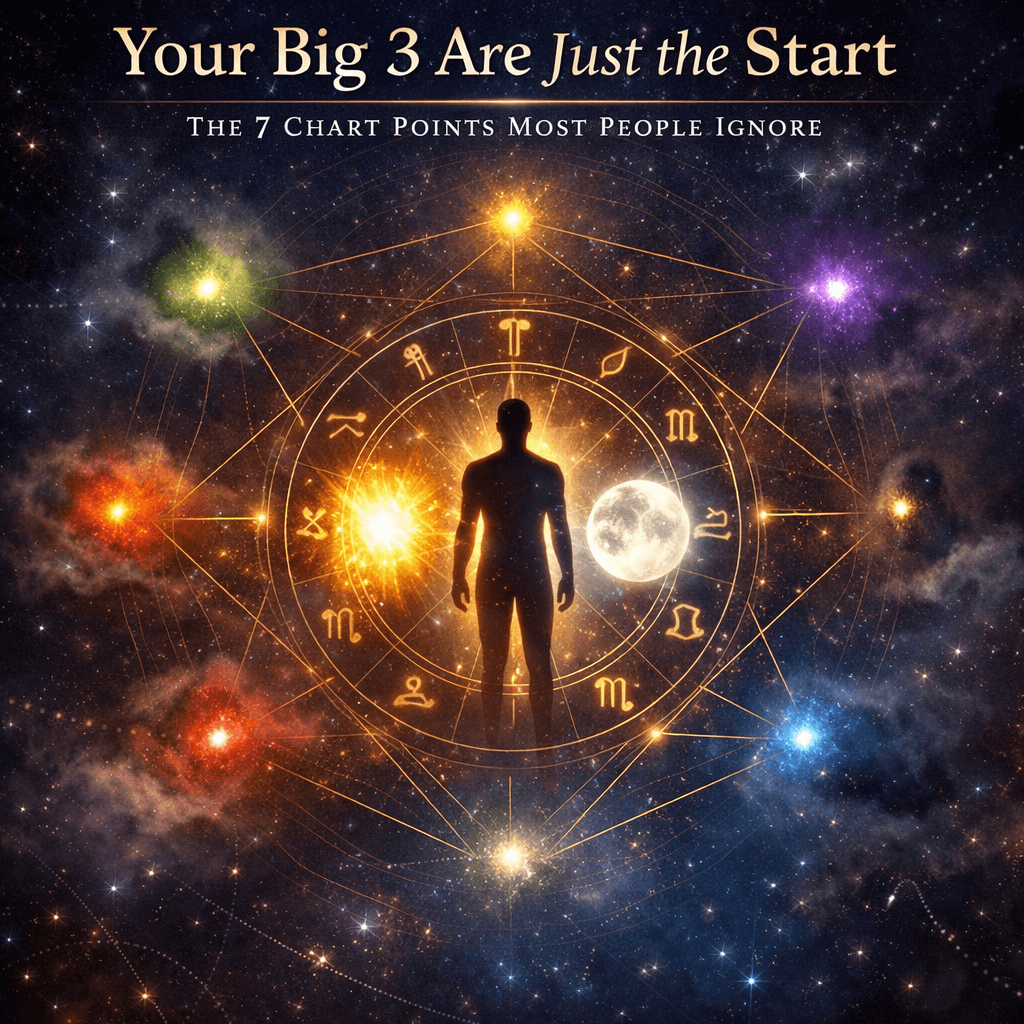
The Big 3 — Sun, Moon, Rising — give you a solid foundation for understanding yourself. But they leave a lot unexplained. Why do you keep repeating the same relationship pattern? What's the underlying direction your life keeps trying to move toward? Where does your deepest wound live, and why does it keep surfacing?
The chart points answer those questions. They're not planets — they're calculated positions based on the relationships between celestial bodies and the Earth. And they're often more revealing than the planetary placements most people spend their time on.
These seven points don't replace the Big 3 — they deepen them. The full picture of who you are and where you're going only emerges when you look at the whole chart together. Start with your free birth chart to see all your placements in one place.
↑ The Rising Sign (Ascendant)
Your Rising sign is the zodiac sign that was rising on the eastern horizon at the exact moment of your birth. It changes every two hours, making it the most time-sensitive placement in your chart. While your Sun sign describes your inner core, your Rising sign describes your outer presentation — the first impression you make, the way you move through the world, the physical qualities others notice first. Many people find that others describe them using their Rising sign rather than their Sun sign. It also sets the structure of your entire house system. → Find your Rising signMC The Midheaven (MC)
The Midheaven is the highest point in your chart — the degree of the zodiac that was directly overhead at your birth. It governs your public reputation, career path, and the legacy you're building. While the 10th house (which the Midheaven anchors) deals with career broadly, the Midheaven sign shows the style and flavour of how you pursue achievement and how you're seen in the wider world. A Midheaven in Aries builds differently than a Midheaven in Pisces. → Find your Midheaven sign☊ The North Node — Your Destiny Direction
The North Node is one of the most important points in the chart for understanding purpose. It's not a planet — it's the point where the Moon's orbit crosses the ecliptic going northward. Astrologers interpret it as the direction your soul is moving toward in this lifetime: the qualities you're here to develop, the experiences you need to grow into. It's often uncomfortable territory — precisely because it's unfamiliar. → Find your North Node☋ The South Node — Where You've Been
Directly opposite the North Node, the South Node represents the qualities you've already mastered — in this life or, depending on your cosmology, in previous ones. It's your default mode: comfortable, familiar, and ultimately limiting if you stay there. Understanding your South Node explains the patterns you fall back into under stress. Moving toward your North Node means consciously stepping away from South Node comfort zones. → Find your South Node⚸ Black Moon Lilith — Raw Power and the Shadow
Black Moon Lilith is one of the most misunderstood points in astrology. It represents the part of yourself that refuses to be tamed — your primal instincts, your shadow, the energy you've been told to suppress. Where Lilith sits in your chart shows where you've experienced shame or exile, and where your most authentic, unfiltered power lives. Working with Lilith means reclaiming the parts of yourself that were deemed too much. → Find your Black Moon Lilith⊕ The Part of Fortune — Where Flow Lives
The Part of Fortune is an Arabic lot — a calculated point derived from the positions of the Sun, Moon, and Ascendant. It marks the area of life where things tend to click into place: where effort feels natural, where luck concentrates, where you find a sense of worldly fulfilment. It's not a guarantee of success, but it's a strong indicator of where to direct your energy for the most return. → Find your Part of FortuneVx The Vertex — Fated Encounters
The Vertex is sometimes called the "third angle" of the chart. It's associated with fated encounters and turning points — the people who arrive in your life and change everything, the events that feel like they were meant to happen. When someone else's planets hit your Vertex, the meeting tends to feel significant in an almost inexplicable way. It's one of the less discussed points but consistently shows up in charts at pivotal moments. → Find your VertexThese seven points don't replace the Big 3 — they deepen them. The full picture of who you are and where you're going only emerges when you look at the whole chart together. Start with your free birth chart to see all your placements in one place.