
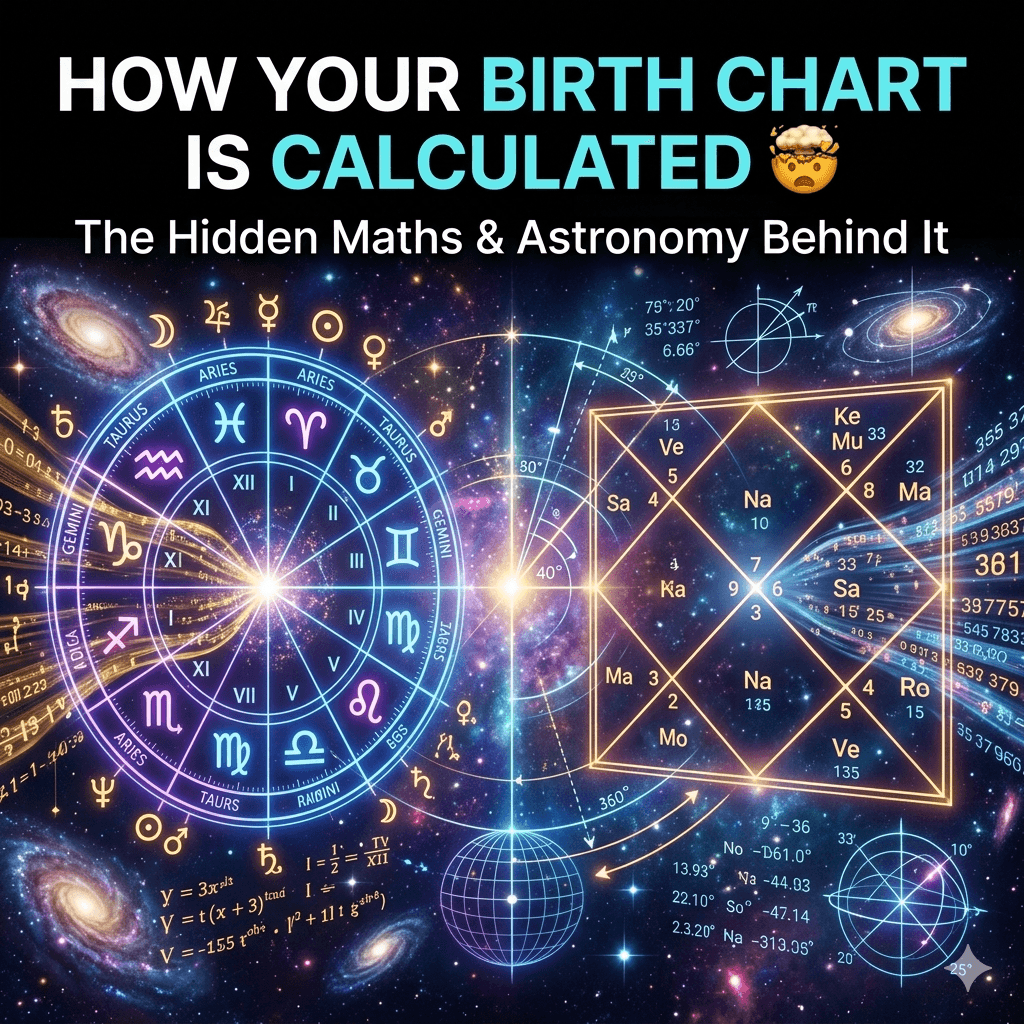
When you enter your birth date, time, and location into Swami and a chart appears seconds later, something precise is happening underneath. Not mysticism — astronomy. The planets were exactly where they were. The maths retrieves that fact. What astrology does with those positions is interpretation. But the positions themselves are as verifiable as any astronomical record.
This post explains exactly how Swami calculates both your Western natal chart and your Vedic (Jyotish) chart — the astronomical engine, the two zodiac systems, the house calculations, the Nakshatra derivation, and the single number that explains why your Vedic Sun sign is different from your Western one. We'll run a real birth date through both pipelines so you can see actual outputs, not abstractions.
The Starting Point — Three Numbers
Every birth chart calculation begins with three inputs: a moment in time, and a point on Earth.
The moment in time is your birth date and time, converted to Universal Coordinated Time (UTC). Local time is only the starting point — Swami applies historical timezone data and daylight saving rules to convert it to UTC before any astronomical calculation begins. This matters more than most people realise: a birth recorded as 2:30 AM in New York in summer 1990 is UTC 06:30, while the same local time in winter is UTC 07:30. Getting this conversion wrong shifts every planetary position.
The point on Earth is your geographic coordinates — latitude and longitude derived from your birth city. These don't affect the positions of the Sun and outer planets meaningfully, but they are essential for calculating the Rising sign (Ascendant) and the entire house system, both of which depend on the local horizon at your exact birth location.
From these three inputs — UTC timestamp, latitude, longitude — every subsequent calculation follows.
The Astronomical Engine — Swiss Ephemeris
Swami's planetary calculations are powered by the Swiss Ephemeris, the same precision astronomical database used by professional astrologers, astronomical observatories, and research institutions worldwide. Swiss Ephemeris is built on JPL DE431 — the Jet Propulsion Laboratory's planetary ephemeris, which is the same dataset NASA uses for spacecraft navigation.
What the Swiss Ephemeris actually does is answer a very precise question: given a Julian Day Number, what is the ecliptic longitude of each planetary body to six decimal places?
The Julian Day Number (JDN) is a continuous count of days from a fixed starting point (noon on January 1, 4713 BCE in the Julian calendar). It eliminates all the complexities of calendars, months, leap years, and time zones by reducing any moment in history to a single number. Your UTC birth timestamp is converted to a JDN before anything else happens. For example, March 21, 1990 at 20:45 UTC converts to JDN 2447941.364583.
With a JDN in hand, Swiss Ephemeris returns the ecliptic longitude of each body — the angular position along the ecliptic (the apparent path of the Sun through the sky) measured in degrees from 0° to 360°. This is the raw astronomical output. Everything that follows — zodiac signs, houses, Nakshatras — is derived from these ecliptic longitudes.
The Western Chart Calculation Pipeline
Western astrology uses the tropical zodiac, which is anchored to the seasons of the Earth rather than the physical star constellations. The tropical zodiac defines 0° Aries as the precise moment of the March equinox — the instant when the Sun crosses the celestial equator heading north. Everything is measured from that seasonal anchor point.
The Western calculation pipeline runs as follows:
Step 1 — UTC conversion. Local birth time → UTC using historical timezone and DST database.
Step 2 — Julian Day Number. UTC timestamp → JDN (continuous astronomical time).
Step 3 — Ecliptic longitudes. Swiss Ephemeris returns the tropical ecliptic longitude of the Sun, Moon, Mercury, Venus, Mars, Jupiter, Saturn, Uranus, Neptune, Pluto, the North Node, Chiron, and other bodies. These are already expressed in the tropical zodiac — no further conversion needed.
Step 4 — Zodiac sign assignment. Each ecliptic longitude maps directly to a zodiac sign: 0°–29.99° = Aries, 30°–59.99° = Taurus, and so on through the 12 signs. A planet at 245.7° ecliptic longitude is at 5.7° Sagittarius (245.7 − 240 = 5.7, and 240° is the start of Sagittarius).
Step 5 — House cusp calculation. This is where geographic coordinates become essential. Swami calculates the Local Sidereal Time (LST) at your birth location using your geographic longitude and the JDN. LST tells us which point of the ecliptic is on the eastern horizon at that exact moment — this is the Ascendant. With the Ascendant established, the remaining 11 house cusps are calculated using the Placidus house system for Western charts (the most widely used system), which divides the diurnal arc of the Sun into equal temporal segments to determine house cusps.
Step 6 — Aspect calculation. Swami computes the angular separations between every pair of planets and identifies aspects: conjunction (0° ± 8°), sextile (60° ± 6°), square (90° ± 8°), trine (120° ± 8°), and opposition (180° ± 8°). The orb tolerances used determine how tight or loose the aspect net is — tighter orbs produce fewer but more certain aspects.
The output of the Western pipeline is your tropical natal chart: every planet in its sign and house, with all aspects between them. This is what almost all Western astrology software produces and what the majority of English-language astrology is written around.
The Ayanamsa — The Number That Splits Western and Vedic
Before explaining the Vedic pipeline, it's necessary to understand the single number that differentiates it from the Western one: the ayanamsa.
Earth's rotational axis wobbles slowly over time — a phenomenon called the precession of the equinoxes. This wobble causes the point of the March equinox to shift very gradually against the backdrop of the fixed stars, moving backward through the zodiac constellations at a rate of approximately 50.3 arc seconds per year, completing a full cycle every ~25,772 years.
The consequence: the tropical zodiac (anchored to the equinox) and the sidereal zodiac (anchored to the actual star constellations) coincided roughly 2,000 years ago, and have been diverging ever since. By 2026, they are approximately 23.86° apart. This gap is the ayanamsa.
The ayanamsa is the correction applied to convert tropical ecliptic longitudes into sidereal ones. Subtract the ayanamsa from any tropical longitude and you get the sidereal longitude — the planet's position relative to the actual star constellations.
Different Vedic astrology traditions use slightly different ayanamsa values. The most widely accepted — and the one Swami uses — is the Lahiri ayanamsa, officially adopted by the Indian government's Calendar Reform Committee in 1955. As of 2026, the Lahiri ayanamsa is approximately 23°51'. The precise value changes slightly each year as precession continues.
This is why most people's Vedic Sun sign is one sign earlier than their Western one. A Sun at 15° Aries tropical becomes 15° − 23°51' = −8°51', which rolls back to 21°09' Pisces in the sidereal zodiac. This is the full explanation for why your Western Sun sign can feel wrong — if you resonate more with Pisces than Aries, your Vedic chart is showing you something real.
The Vedic Chart Calculation Pipeline
The Vedic pipeline begins identically to the Western one — same UTC conversion, same JDN, same Swiss Ephemeris call returning tropical ecliptic longitudes. The divergence happens at Step 3:
Step 3 (Vedic) — Ayanamsa subtraction. Swami subtracts the Lahiri ayanamsa from every tropical ecliptic longitude. Sun at 0°42' Aries tropical becomes 0°42' − 23°51' = 6°51' Pisces sidereal. Every planet shifts by the same amount. This single subtraction converts the entire tropical chart into a sidereal one.
Step 4 (Vedic) — Sidereal zodiac sign assignment. The same sign assignment logic applies, but now to sidereal longitudes. The 12 Vedic signs (Rashis) span the same 30° segments, but measured against the actual constellations rather than the equinoctial point.
Step 5 (Vedic) — Whole sign house system. Vedic astrology predominantly uses the whole sign house system rather than Placidus. In whole sign houses, the Ascendant sign becomes the entire 1st house — every planet in that sign is in the 1st house regardless of the Ascendant's exact degree. The 2nd house is the next sign entirely, the 3rd house the next, and so on. This differs meaningfully from the Placidus division used in Western astrology, and can move planets between houses when comparing the two charts.
Step 6 (Vedic) — Nakshatra calculation. The Moon's sidereal longitude is used to calculate the birth Nakshatra. This is a separate calculation described fully in the next section.
Step 7 (Vedic) — Dasha balance calculation. The Nakshatra and the Moon's position within it determine the starting point of the Vimshottari Dasha sequence — the planetary period system that governs the timing of life events. The Dasha Period Calculator uses this output to tell you which planetary period you are currently in.
The Nakshatra Calculation — The Maths of 1 in 108
The Nakshatra is derived entirely from the Moon's sidereal ecliptic longitude. The maths is elegant in its simplicity.
The 360° of the sidereal zodiac is divided into 27 equal Nakshatras, each spanning exactly 13°20' (or 13.333...°). To find which Nakshatra the Moon occupies:
Moon sidereal longitude = L  (0° to 360°)
Nakshatra number = floor(L ÷ 13.3333) + 1
Nakshatra remainder = L mod 13.3333
For example: Moon at 78.25° sidereal.
78.25 ÷ 13.3333 = 5.869
floor(5.869) = 5
Nakshatra = 5 + 1 = 6 → Ardra
Remainder = 78.25 − (5 × 13.3333) = 78.25 − 66.6665 = 11.5835°
The remainder tells us the position within Ardra. Each Nakshatra is further divided into 4 Padas (quarters) of 3°20' (3.3333°) each:
Pada number = floor(remainder ÷ 3.3333) + 1
11.5835 ÷ 3.3333 = 3.475
floor(3.475) = 3
Pada = 3 + 1 = 4 → 4th Pada of Ardra
With 27 Nakshatras × 4 Padas = 108 total positions, your specific Moon placement is 1 of 108 rather than 1 of 12. That's the mathematical precision behind the claim that Nakshatras are more specific than Sun signs — the numbers make it literal. Read the full explanation in: What Is a Nakshatra and Why It's More Accurate Than Your Sun Sign.
How the Nakshatra Determines Your Dasha Sequence
The Nakshatra doesn't just describe your personality — it's the seed of the entire Vimshottari Dasha timing system. Each Nakshatra is ruled by one of nine planets, and that ruling planet determines which Dasha you were born into and how much of it remained at birth.
The calculation works like this: each Nakshatra spans 13°20'. Your Moon's position within that Nakshatra (the remainder from the calculation above) tells you what proportion of the ruling planet's Dasha had already elapsed at birth.
Nakshatra remainder = 11.5835° (from Ardra example above)
Ardra ruler = Rahu (18-year Dasha)
Proportion elapsed = 11.5835 ÷ 13.3333 = 0.8688 = 86.88%
Rahu Dasha elapsed at birth = 18 × 0.8688 = 15.64 years
Rahu Dasha remaining at birth = 18 − 15.64 = 2.36 years
From that remaining balance, the Dasha sequence continues in the fixed Vimshottari order: Rahu → Jupiter → Saturn → Mercury → Ketu → Venus → Sun → Moon → Mars → and then cycling back. Each period lasts its full allotted years (Rahu 18, Jupiter 16, Saturn 19, Mercury 17, Ketu 7, Venus 20, Sun 6, Moon 10, Mars 7). The Dasha Period Calculator runs this sequence from your birth date forward to today and tells you exactly where you are in the cycle.
For the deeper explanation of what each Dasha period means for your life: Your Dasha Period Is Running Your Life Right Now — Here's How to Read It.
House Systems — Where Most Calculators Differ
The house system is the most consequential area of difference between astrology software tools, and the most common reason a planet appears in different houses when you compare charts from different sources.
There are over a dozen house systems in use. The main ones are:
| House System | Method | Used In |
|---|---|---|
| Placidus | Divides the diurnal arc of the ecliptic into equal time segments | Western (default in most software) |
| Whole Sign | Each house = one complete zodiac sign, starting from the Ascendant sign | Vedic (Jyotish standard), Hellenistic Western |
| Koch | Similar to Placidus but uses birthplace latitude more heavily | Western (Germany, Northern Europe) |
| Equal House | Each house = exactly 30°, starting from the Ascendant degree | Western (UK tradition, beginners) |
| Campanus | Divides the prime vertical into equal 30° segments | Western (less common) |
Swami uses Placidus for Western charts and whole sign for Vedic charts. These are the respective defaults in each tradition and the systems used by the majority of practising astrologers in each.
The practical consequence of different house systems is that a planet sitting near a house cusp — within 5° of a boundary — can appear in different houses depending on which system is used. Placidus and whole sign often agree, but diverge particularly for birth times around midnight or noon, and for births at high latitudes where Placidus cusps can become highly irregular. If your planet is right on a cusp, both interpretations have validity — the planet is operating on the boundary of both life areas.
A Worked Example — March 21, 1990, 3:45 PM, New York
Here is the actual calculation pipeline for a specific birth: March 21, 1990, 3:45 PM local time, New York City (40.7128°N, 74.0060°W).
UTC conversion: New York in March 1990 was on Eastern Standard Time (UTC−5). 3:45 PM EST = 20:45 UTC. Date: March 21, 1990 20:45 UTC.
Julian Day Number: JDN = 2447941.3646
Swiss Ephemeris output (tropical ecliptic longitudes):
| Body | Tropical Longitude | Western Sign |
|---|---|---|
| Sun | 0°42' Aries | Aries ♈ |
| Moon | 105°14' (15°14' Cancer) | Cancer ♋ |
| Mercury | 358°54' (28°54' Pisces) | Pisces ♓ |
| Venus | 42°18' (12°18' Taurus) | Taurus ♉ |
| Mars | 275°32' (5°32' Capricorn) | Capricorn ♑ |
| Jupiter | 111°45' (21°45' Cancer) | Cancer ♋ |
| Saturn | 288°09' (18°09' Capricorn) | Capricorn ♑ |
Ascendant (Western / Placidus): With birth at 40.71°N, 74.01°W, Local Sidereal Time at 20:45 UTC calculates to approximately 16h 52m. The Ascendant is approximately 22° Leo.
Ayanamsa application (Lahiri, 2026 value ≈ 23°51'):
| Body | Tropical | Sidereal (−23°51') | Vedic Sign |
|---|---|---|---|
| Sun | 0°42' Aries | 6°51' Pisces | Pisces ♓ |
| Moon | 15°14' Cancer | 21°23' Gemini | Gemini ♊ |
| Mercury | 28°54' Pisces | 5°03' Pisces | Pisces ♓ |
| Venus | 12°18' Taurus | 18°27' Aries | Aries ♈ |
| Mars | 5°32' Capricorn | 11°41' Sagittarius | Sagittarius ♐ |
| Jupiter | 21°45' Cancer | 27°54' Gemini | Gemini ♊ |
| Saturn | 18°09' Capricorn | 24°18' Sagittarius | Sagittarius ♐ |
Moon Nakshatra calculation:
Moon sidereal = 81.383° (21°23' Gemini = 60° + 21.383°)
Nakshatra = floor(81.383 ÷ 13.333) + 1 = floor(6.104) + 1 = 7
Nakshatra 7 = Punarvasu (ruler: Jupiter, 16-year Dasha)
Remainder = 81.383 − (6 × 13.333) = 81.383 − 79.998 = 1.385°
Pada = floor(1.385 ÷ 3.333) + 1 = floor(0.4155) + 1 = 1
Birth Nakshatra: Punarvasu, 1st Pada
This person was born in Punarvasu Nakshatra, 1st Pada — a Nakshatra associated with renewal, optimism, and a deep pull toward home and return. Their Dasha at birth began in Jupiter's period, which runs for 16 years. To find what Dasha period this person is in today, use the Dasha Period Calculator.
Notice what the ayanamsa correction reveals: this person's Western chart shows a Sun in Aries and Moon in Cancer — the classic "fiery initiator with sensitive inner life" combination. Their Vedic chart shows a Sun in Pisces and Moon in Gemini — spiritually oriented, mentally agile, and highly adaptable. Neither chart is wrong. They're describing the same person through two different lenses, each of which has genuine explanatory power in its own tradition. This is explored in depth in: Western vs Vedic Astrology: What's the Difference and Which Is More Accurate?
Accuracy Factors — What Can Affect Your Results
Swami's calculations are as accurate as the inputs allow. There are four factors that affect precision:
Birth time precision. The Rising sign changes every ~2 hours. A 10-minute error in birth time can shift the Ascendant degree, and a 2-hour error can change the Rising sign entirely. The Moon moves approximately 13° per day — a 1-hour error shifts the Moon by about 0.54°, which can change the Nakshatra Pada and in borderline cases the Nakshatra itself. For everything except the Rising sign and house cusps, even a 30-minute error in birth time makes negligible difference to the slow-moving outer planets.
Historical timezone data. Timezone rules have changed many times throughout history, and not all changes are consistently documented — particularly in some regions of South Asia, South America, and parts of Africa prior to 1970. Swami uses the IANA timezone database (the most comprehensive historical timezone record available), but edge cases exist for births in regions with irregular historical timezone records.
Daylight saving time. DST rules have varied enormously by country, state, and year. Several countries have changed their DST observance multiple times. A birth recorded at 2:30 AM during a spring clock-change is potentially ambiguous — that time may not have existed (clocks jumped from 2:00 to 3:00), or it may fall in the gap during a fall change. Swami flags ambiguous DST times rather than silently guessing.
Ayanamsa choice. Different Vedic traditions use different ayanamsa values. Lahiri (used by Swami) is the Indian government standard and the most widely used. The Raman ayanamsa differs by about 1°, and the Krishnamurti ayanamsa differs by about 6'. For planets near sign boundaries, a different ayanamsa choice would place the planet in a different sign. This is why two different Vedic calculators sometimes give different results for the same birth data — they may be using different ayanamsa values.
The Two Pipelines Side by Side
| Step | Western Chart | Vedic Chart |
|---|---|---|
| Time input | Local time → UTC | Local time → UTC |
| Astronomical time | UTC → Julian Day Number | UTC → Julian Day Number |
| Planetary positions | Swiss Ephemeris (tropical) | Swiss Ephemeris (tropical) |
| Zodiac correction | None — tropical used directly | Subtract Lahiri ayanamsa (~23°51') |
| Sign assignment | Tropical 30° segments | Sidereal 30° segments |
| House system | Placidus | Whole sign |
| Ascendant | Exact ecliptic degree on eastern horizon | Same degree, sidereal; whole sign from that sign |
| Additional layers | Aspects between planets | Nakshatra, Pada, Dasha sequence |
| Timing system | Transits, progressions | Vimshottari Dasha periods |
Why Swami Shows Both
Most astrology calculators show you one system. The reason Swami shows both is not to create confusion but to give you access to genuinely different information.
Western astrology, built around the tropical zodiac and psychological interpretation developed through the 20th century, excels at describing your inner psychological landscape — the archetypal patterns of your personality, your relational dynamics, and the developmental themes of your life. It asks: what kind of person are you becoming?
Vedic astrology, built around the sidereal zodiac and a 5,000-year tradition of precise timing prediction, excels at describing the quality and sequence of experience — when things are likely to happen, what karmic themes are active, and how your soul is moving through this incarnation. Its Dasha system provides a level of timing precision that Western astrology's transit system approaches but doesn't quite match. It asks: when will things move, and in what direction?
Used together, they are complementary maps of the same territory — one describing the landscape, one describing the journey through it. The planetary positions are identical. The interpretive frameworks are different. Both have earned their place through millennia of practitioner observation and refinement.
The full comparison of what each system reveals — and which to trust for which kind of question — is in: Western vs Vedic Astrology: What's the Difference and Which Is More Accurate?
Try It Yourself
The best way to understand what this calculation produces is to run it for your own data. The Swami Birth Chart Calculator generates both your Western and Vedic charts simultaneously — you'll see exactly the kind of side-by-side output the worked example above demonstrates, with your own planetary positions, house placements, Nakshatra, and Dasha period.
From there, you can explore individual placements with the Moon Sign Calculator, Rising Sign Calculator, Nakshatra Calculator, and Dasha Period Calculator — each of which goes deeper into a specific layer of the chart than a full birth chart reading can within a single page.
If you're currently in your late 20s, the Saturn Return Calculator is worth checking — Saturn's return to its birth position at approximately age 29.5 is one of the most reliably significant transits in the Western system, and its timing is calculated using the same Swiss Ephemeris pipeline described here.
→ Generate your Western + Vedic birth chart now