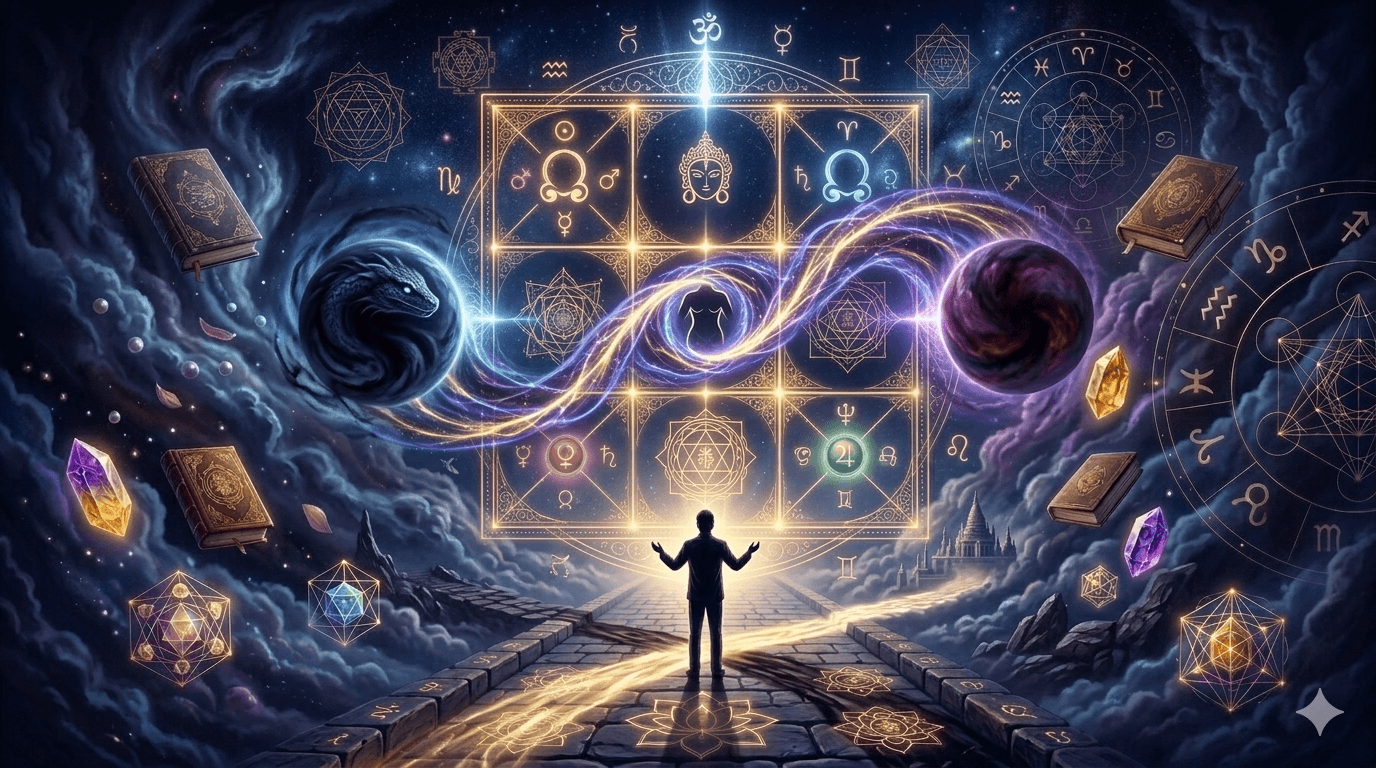
Rahu and Ketu are not planets. They have no mass, emit no light, and cannot be seen with the naked eye. They are mathematical points — the two places where the Moon's orbital plane intersects the ecliptic (the Sun's apparent path). In Western astrology they are called the North Node and South Node of the Moon. In Vedic astrology they are granted full planetary status, assigned their own Dashas, and considered among the most powerful indicators in the entire birth chart.
The reason is this: the lunar nodes mark the axis along which eclipses occur. An eclipse happens only when the Sun and Moon are both near a nodal point simultaneously — which is why the nodes are associated with sudden, fated, and irreversible events. In Jyotish, Rahu and Ketu are not merely points of astronomical interest but indicators of karmic intention — what your soul is moving toward (Rahu) and what it is moving away from (Ketu). You can find both in your chart using the North Node Calculator and South Node Calculator.
The Mythology — Svarbhanu and the Amrita
The Vedic mythology of Rahu and Ketu begins with the churning of the cosmic ocean (Samudra Manthan), during which the gods and demons together produced Amrita — the nectar of immortality. As the gods began distributing the Amrita among themselves, a demon named Svarbhanu disguised himself as a god and drank some of it. The Sun and Moon recognised the deception and alerted Vishnu, who immediately severed Svarbhanu's head with the Sudarshana Chakra.
But Svarbhanu had already swallowed some of the Amrita and could not die. His severed head became Rahu; his headless body became Ketu. Both were granted planetary status and given a place in the celestial order. Rahu periodically takes revenge by swallowing the Sun and Moon — which is what we observe as solar and lunar eclipses. The Sun and Moon escape quickly, and the eclipse ends — but the nodes remain as permanent fixtures in every birth chart, always pointing to the axis of karmic tension.
The symbolism is precise. Rahu is the head without a body — all appetite, obsession, and desire, but no digestion or grounding. Ketu is the body without a head — all instinct and capability, but no direction or desire. Together they represent the fundamental tension between craving and detachment that structures karmic experience.
Rahu — The North Node
Rahu represents the direction your soul is moving in this incarnation — the unfamiliar territory you are meant to explore, the qualities you are developing for the first time, and the desires that compel you forward even when they feel uncomfortable or destabilising. Rahu's house and sign in your chart describe:
- Obsessive attraction: The area of life you are drawn to with unusual intensity — sometimes to excess, sometimes to your detriment, but always with evolutionary purpose
- The new and foreign: Rahu is associated with foreignness, innovation, technology, and whatever lies outside your inherited comfort zone
- Illusion and maya: Rahu can create glamour, ambition, and the restless sense that fulfilment lies just ahead — always slightly out of reach
- Material world: Where Ketu renounces, Rahu grasps. Rahu's house often shows where material success and worldly ambition are strongest
Rahu is exalted in Taurus (or Gemini, depending on the tradition) and debilitated in Scorpio (or Sagittarius). It behaves like Saturn in its general restrictive and karmic quality, but with the additional dimension of obsession and illusion. Rahu's Mahadasha lasts 18 years — the longest of any node — and is known for ambition, sudden rise, foreign connections, and the pursuit of worldly achievement mixed with periodic disorientation. For the full Dasha context: Dasha Period Calculator.
Ketu — The South Node
Ketu represents where your soul has already been — the qualities, skills, and life areas that are deeply familiar from past experience (past lives in the traditional Vedic framework, or early childhood and ancestral patterns in a psychological reading). Ketu's house and sign describe:
- Mastery without effort: The area of life where you are naturally capable but paradoxically detached — it comes too easily to feel meaningful
- Renunciation and loss: Ketu dissolves what it touches. Planets conjunct Ketu often show areas where attachment is repeatedly stripped away, pushing toward spiritual surrender
- Spiritual gifts: Ketu rules moksha (liberation) and is the most spiritual of the planetary indicators. Strong Ketu placements often indicate psychic ability, spiritual inclination, and access to non-ordinary states of consciousness
- Isolation and withdrawal: Ketu prefers the inner world. Its house can show where solitude, retreat, or disengagement from the material world feels natural
Ketu is exalted in Scorpio (or Sagittarius) and debilitated in Taurus (or Gemini). It behaves like Mars — sharp, sudden, cutting, and capable of both destruction and illumination. Ketu's Mahadasha lasts 7 years and is associated with spiritual deepening, sudden insight, release of attachment, and sometimes significant loss that leads to liberation.
Rahu and Ketu Through the 12 Houses
| Rahu House | Rahu Themes (Growth Direction) | Ketu House | Ketu Themes (Release Direction) |
|---|---|---|---|
| 1st | Identity reinvention, personal ambition, foreign body/appearance | 7th | Dissolving partnership dependency, spiritual relationships |
| 2nd | Wealth obsession, foreign languages, family complexity | 8th | Detachment from taboo, deep transformation completed |
| 3rd | Communication, media, siblings, bold self-expression | 9th | Releasing inherited beliefs, completing the dharmic quest |
| 4th | Home, property, mother, emotional security seeking | 10th | Career detachment, past-life public role releasing |
| 5th | Creativity, romance, speculation, children | 11th | Detachment from social networks and material gains |
| 6th | Service, health, enemies, competitive drive | 12th | Past-life spiritual completion, moksha-oriented isolation |
| 7th | Partnerships, marriage, foreign spouse, public persona | 1st | Releasing ego fixation, spiritual self-dissolution |
| 8th | Occult, transformation, inheritance, hidden power | 2nd | Releasing family wealth attachment, speech purification |
| 9th | Foreign philosophy, higher education, dharma seeking | 3rd | Releasing sibling karma, past-life communication mastery |
| 10th | Career ambition, status, public life, foreign profession | 4th | Detachment from homeland, releasing maternal karma |
| 11th | Gains, networks, large organisations, foreign friends | 5th | Past-life creative completion, releasing ego through creativity |
| 12th | Foreign lands, spiritual seeking, isolation as path | 6th | Completing the cycle of service and health karma |
Rahu and Ketu Through the Signs
Rahu and Ketu always occupy opposite signs — they are always exactly 180° apart. The sign Rahu occupies colours the nature of its obsession; the sign Ketu occupies colours what is being released. Because they move retrograde through the zodiac, completing a full cycle in approximately 18.6 years, they spend about 1.5 years in each sign pair.
Rahu in Aries / Ketu in Libra: Learning to act independently and lead; releasing over-dependence on partnership approval.
Rahu in Taurus / Ketu in Scorpio: Building material stability and sensory groundedness; releasing obsession with depth, taboo, and transformation.
Rahu in Gemini / Ketu in Sagittarius: Developing communication, curiosity, and adaptability; releasing fixed philosophical systems and dogma.
Rahu in Cancer / Ketu in Capricorn: Cultivating emotional intelligence and home-building; releasing past-life authority structures and career identity.
Rahu in Leo / Ketu in Aquarius: Developing authentic self-expression and creative individuality; releasing group-identity and humanitarian abstraction.
Rahu in Virgo / Ketu in Pisces: Developing analytical skill, practical service, and discernment; releasing spiritual dissolution and escapism.
The reverse signs follow naturally: Rahu in Libra/Ketu in Aries, Rahu in Scorpio/Ketu in Taurus, and so on through the zodiac.
Rahu and Ketu Nakshatras — The Nodal Axis in Detail
The Nakshatra occupied by Rahu and Ketu adds significant precision to nodal interpretation. Rahu in the 6°40'–20° Aquarius segment is in Shatabhisha Nakshatra — a very different expression of Rahu than Rahu in 23°20' Capricorn–6°40' Aquarius (Dhanishta). The Nakshatra's ruling planet, deity, and symbol all colour the expression of the nodal energy. Use the Birth Chart Calculator to see your Rahu and Ketu Nakshatra positions in full.
Western North Node vs Vedic Rahu — Are They the Same?
The astronomical point is identical — both Western and Vedic astrology are referring to the Moon's ascending node. The interpretive framework differs significantly. Western astrology treats the North Node as the direction of soul growth and the South Node as habitual comfort zone — broadly paralleling Rahu (North) and Ketu (South) in Vedic astrology.
The key differences: Vedic astrology grants Rahu and Ketu full Dasha periods (18 and 7 years respectively) that activate nodal themes at specific life stages. Western astrology does not have an equivalent timing mechanism specifically for the nodes. Vedic astrology also gives Rahu and Ketu rulership over specific Nakshatras (Rahu: Ardra, Swati, Shatabhisha; Ketu: Ashwini, Magha, Mula), connecting them into the Dasha architecture in ways Western astrology does not. The karmic framework in Karmic Debt, Past Lives, and Your North Node bridges both traditions.