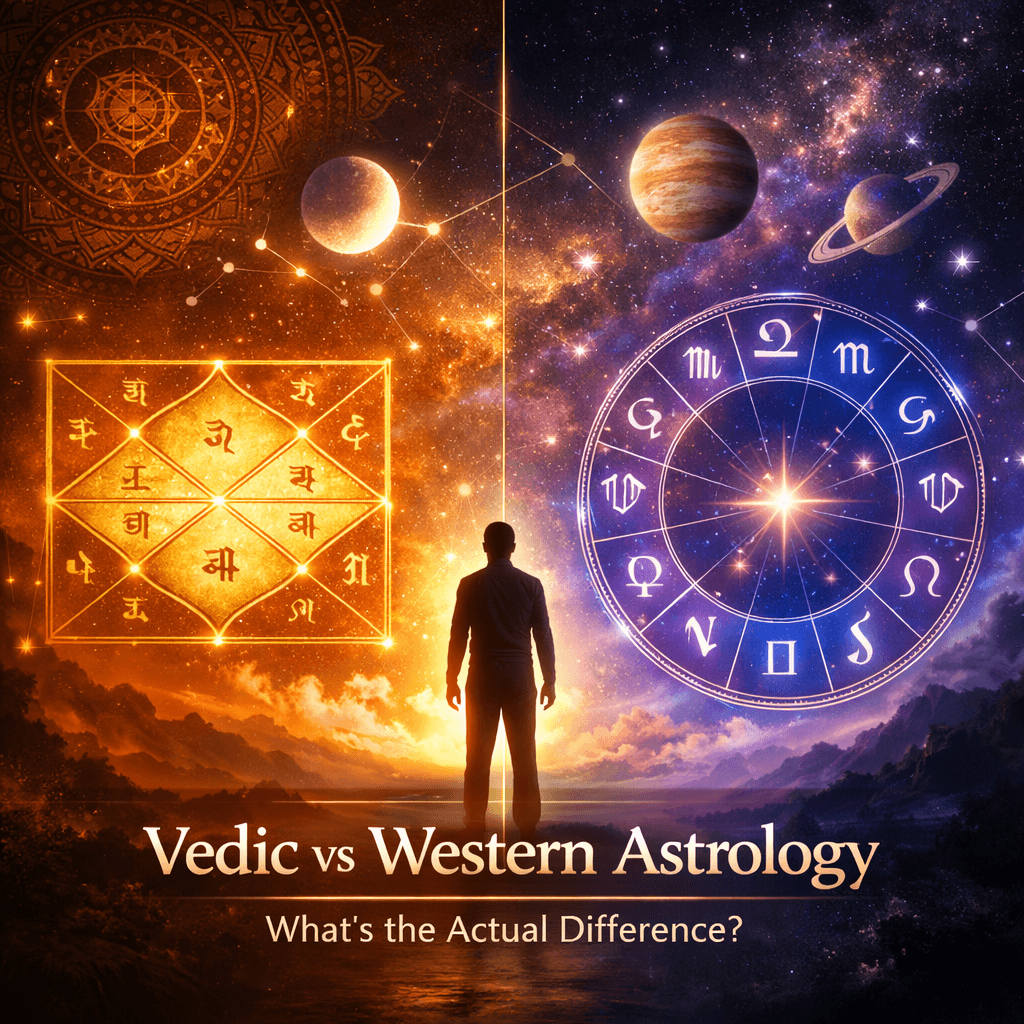
This is the question that comes up most often for people who've been using Western astrology and then encounter Vedic for the first time. They run a Vedic chart, see that their Sun sign has shifted — often by one sign — and don't know what to do with that. The short answer is: both systems are accurate within their own frameworks, and they're answering different questions.
The Core Technical Difference: Tropical vs Sidereal
Western astrology uses the
tropical zodiac — a system aligned with the seasons rather than the actual positions of the constellations. The tropical zodiac fixes Aries at the Spring Equinox (around March 21st) regardless of where the constellation Aries actually sits in the sky. This system drifts over time due to the precession of the equinoxes — the slow wobble of the Earth's axis — and is currently about 23-24 degrees behind the actual star positions.
Vedic astrology uses the
sidereal zodiac — a system aligned with the actual observable positions of the constellations. It uses an adjustment called the ayanamsha to correct for precession. The result is that most planetary positions in a Vedic chart are shifted back by approximately one zodiac sign compared to a Western chart. A Western Scorpio Sun often becomes a Libra Sun in Vedic. A Western Aries Moon may become a Pisces Moon.
Neither system is wrong. They're measuring different things.
What Western Astrology Does Well
Western astrology excels at psychological portrait. Its focus on the natal chart as a map of personality — the inner architecture of the self, the emotional patterns, the relational dynamics — is deeply developed. The emphasis on aspects, chart shapes, and psychological interpretation makes Western astrology particularly strong for understanding
who you are and why you behave as you do.
Modern Western astrology has also integrated heavily with psychology, particularly Jungian concepts. The shadow, the anima/animus, the archetypal dimensions of each planet — these have been woven into Western astrological practice over the past century in ways that make it a powerful tool for inner work.
What Vedic Astrology Does Well
Vedic astrology — also called Jyotish, meaning "science of light" — excels at timing and prediction. Its system of Dasha periods (planetary timing cycles that govern specific phases of life) is one of the most sophisticated timing tools in any astrological tradition. The Mahadasha system assigns each planet a ruling period of several years, and within each Mahadasha are sub-periods (Antardashas) that further refine the timing. When astrologers accurately predict life events, they're usually working with Dasha periods.
Vedic astrology also uses divisional charts — additional chart layers cast for specific life areas. The Navamsa (D9 chart) is particularly important for relationships and the second half of life. The Dashamsha (D10) governs career. These give a level of granularity that Western astrology doesn't have an equivalent for.
Additionally, the Nakshatra system — 27 lunar mansions that divide the zodiac more finely than the 12 signs — adds another layer of precision, particularly for understanding the Moon's placement.
Why Your Sign "Changes"
When people first run a Vedic chart and see their Sun sign shift, they often feel confused or resistant. The most useful framing is this: your Western Sun sign still accurately describes your conscious identity and ego expression. Your Vedic Sun sign describes your soul's orientation in this lifetime, filtered through the lens of actual stellar positions. They're complementary, not contradictory.
Many experienced astrologers work with both. They use Western astrology for psychological insight and inner work, and Vedic astrology for timing and predictive work. The two systems together give a more complete picture than either does alone — which is exactly what Swami is built to provide.
Where to Start
If you've only ever used Western astrology, the most useful next step is running your Vedic birth chart and paying attention to three things: your Vedic Moon sign (often more significant than the Sun in Vedic), your Ascendant (called the Lagna), and your current Mahadasha period.
→
Run your free Vedic Birth Chart
→
Find your Nakshatra (birth star)
→
See your current Dasha period