It's the most common question in astrology today:
Western or Vedic — which one is right?
People discover that their sun sign shifts by a whole sign when they switch systems, and suddenly they want to know which chart to trust. The answer might surprise you: both systems are valid, both are ancient, and they were never really meant to compete. They were built for entirely different purposes.
Here's a complete, honest breakdown of how they differ — and what happens when you use them together.
The Core Difference: How They Measure the Sky
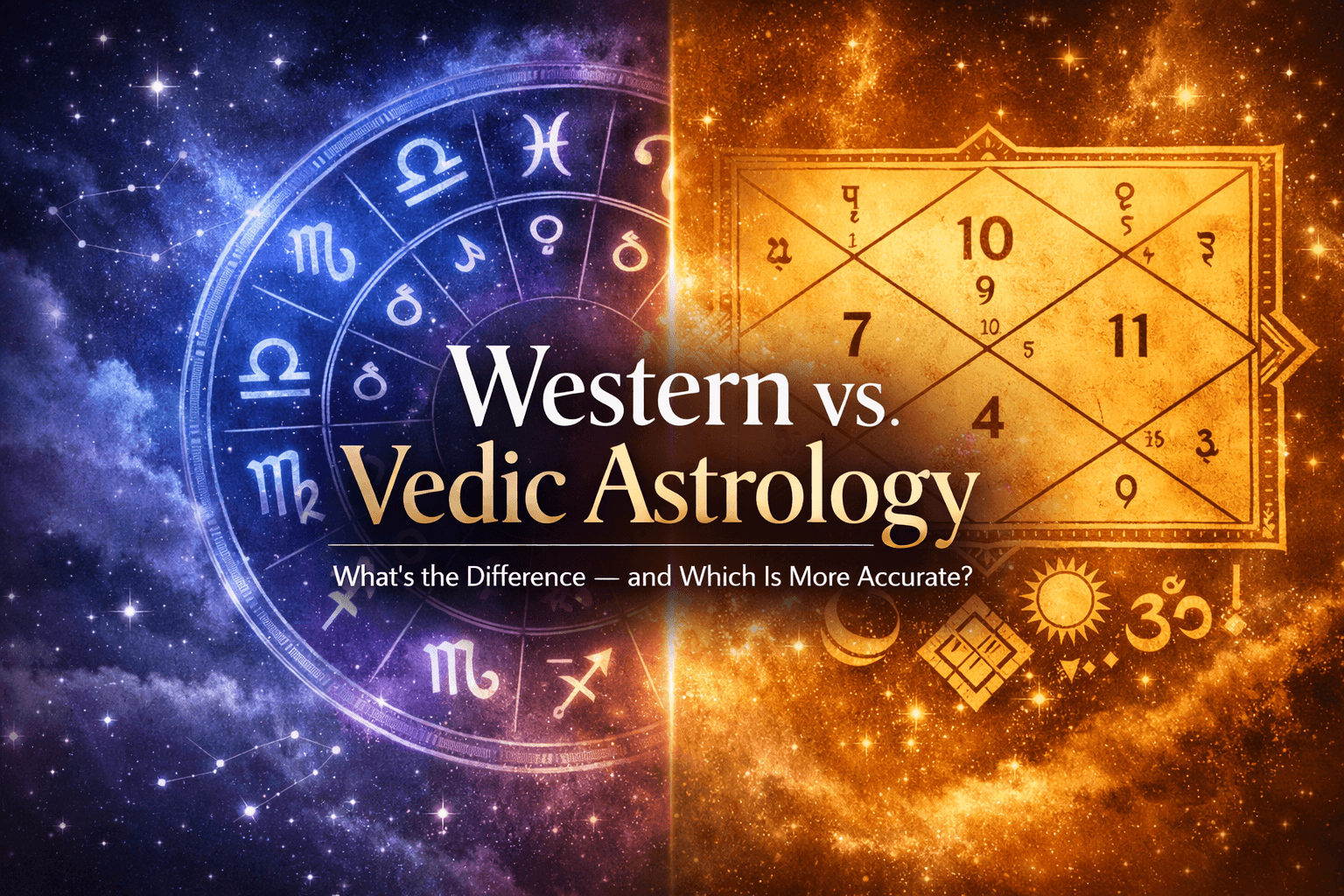
Everything else flows from one fundamental difference in how the two systems measure the zodiac.
Western astrology uses the tropical zodiac. The tropical zodiac is anchored to the seasons, not the stars. Aries begins at the March equinox every single year. This system was defined by ancient Greek astronomers around 2,000 years ago and has remained fixed ever since.
Vedic astrology uses the sidereal zodiac. The sidereal zodiac tracks the actual position of constellations in the sky as they exist right now. Because Earth wobbles on its axis over long cycles (called the precession of the equinoxes), the tropical and sidereal zodiacs have gradually drifted apart. Today, they're separated by roughly 23–24 degrees — just under one full zodiac sign.
This is why your Vedic sun sign is usually one sign earlier than your Western sun sign. If you're a Western Sagittarius, you're likely a Vedic Scorpio. If you're a Western Taurus, you're likely a Vedic Aries.
Their Different Philosophies and Goals
Beyond the technical difference, the two systems were built with entirely different goals in mind.
Western astrology is primarily psychological. It developed alongside modern psychology in the 20th century, and today it focuses on understanding the self — your personality, your patterns, your shadow, your unconscious motivations. It asks: who are you, and why do you behave the way you do?
Vedic astrology is primarily predictive and karmic. Rooted in the Vedic scriptures of ancient India, Jyotish (its Sanskrit name, meaning "science of light") focuses on karma, dharma, and the timing of life events. It asks: what is your soul here to learn, and when will the major chapters of your life unfold?
Neither approach is superior. They're complementary. Western astrology gives you a mirror. Vedic astrology gives you a map.
Key Technical Differences at a Glance
What Western Astrology Does Better
Western astrology genuinely excels in certain areas that Vedic simply doesn't emphasize:
Psychological depth. The Western system's integration with Jungian archetypes and modern psychology makes it unparalleled for self-understanding. Concepts like the shadow, the inner child, and unconscious patterns are woven into modern Western chart interpretation in ways Vedic doesn't replicate.
Outer planet transits. Uranus, Neptune, and Pluto are not used in traditional Vedic astrology. These slow-moving planets (taking 84, 165, and 248 years respectively to orbit the sun) describe generational themes and sudden, disruptive life changes in ways that the Vedic system addresses differently.
Relationship compatibility. Western synastry — the technique of overlaying two charts to examine relationship dynamics — is extraordinarily detailed. House overlays, aspect patterns between partners, and composite charts provide nuance that goes beyond what most Vedic compatibility tools offer.
What Vedic Astrology Does Better
Vedic astrology has capabilities that make experienced astrologers of both traditions take notice:
Timing of life events. The Dasha system is Vedic astrology's crown jewel. It divides your entire life into planetary periods — each planet rules a cycle of years in a specific sequence based on your Nakshatra at birth. Experienced Vedic astrologers can identify the approximate timing of marriage, career changes, health events, and major transitions with a level of precision that Western astrology's transit system rarely matches.
The Nakshatras. The 27 Nakshatra system provides a granularity of personality description that the 12-sign zodiac simply can't achieve. Two people born with Moon in Scorpio may have completely different Nakshatras — Anuradha versus Jyeshtha — and their emotional natures, karmic themes, and life paths will differ significantly as a result.
Karmic clarity. The Vedic treatment of Rahu and Ketu (the lunar nodes) as karmic indicators is richer and more developed than most Western approaches. Rahu shows where your soul is hungry and growing. Ketu shows what you've already mastered and are meant to release. Together they map the karmic arc of this lifetime.
Which System Is More "Accurate"?
This is the question everyone wants answered, and the honest answer is: it depends on what you're trying to understand.
If you're exploring your psychology, patterns, and relationships — Western astrology is likely to resonate more deeply. Its language is closer to how modern people think about themselves.
If you're trying to understand the timing of your life, your karmic purpose, or why certain patterns keep repeating — Vedic astrology often provides answers that Western cannot.
Many experienced astrologers eventually study both systems and use them together. Not because one is more accurate, but because the complete truth about a person's life requires both lenses.
Why Using Both Together Is the Most Powerful Approach
Think of it this way: Western astrology shows you
who you are. Vedic astrology shows you
why you're here. The two systems don't contradict each other — they illuminate different layers of the same person.
When you read both charts simultaneously, you can see:
- Your psychological personality (Western sun, moon, rising)
- Your karmic purpose and soul lessons (Vedic chart, Rahu/Ketu)
- Your most accurate personality fingerprint (your Nakshatra)
- The current chapter of your life (your active Dasha period)
- Where you're heading (transits interpreted through both lenses)
This is exactly what Swami was built to provide: both charts, side by side, with plain-language interpretations that make both systems accessible — whether you're a complete beginner or a seasoned astrology enthusiast.
Run your free Western + Vedic chart now and see both systems at once →
Frequently Asked Questions
Can I have a different sun sign in Vedic vs Western astrology?
Yes — this is very common. Because of the ~23 degree difference between the tropical and sidereal zodiacs, most people's sun sign shifts by one sign when they move from Western to Vedic. Both placements are valid and describe different aspects of who you are.
Should I use my Western or Vedic rising sign?
Both are worth knowing. Your Western rising describes your outward personality and appearance. Your Vedic rising (Lagna) is the foundation of your entire Vedic chart and governs the placement of all houses — it's arguably even more important in Jyotish than in Western astrology.
Do professional astrologers use both systems?
Increasingly, yes. Many modern astrologers trained in both traditions find that using both systems together provides a more complete and accurate reading than either system alone.
Is Vedic astrology only for Hindu people?
No. While Vedic astrology originated in ancient India and is embedded in Hindu spiritual tradition, the system itself is universal. Your chart is calculated from your birth data regardless of your religion, background, or beliefs. Anyone can benefit from Vedic insights.