
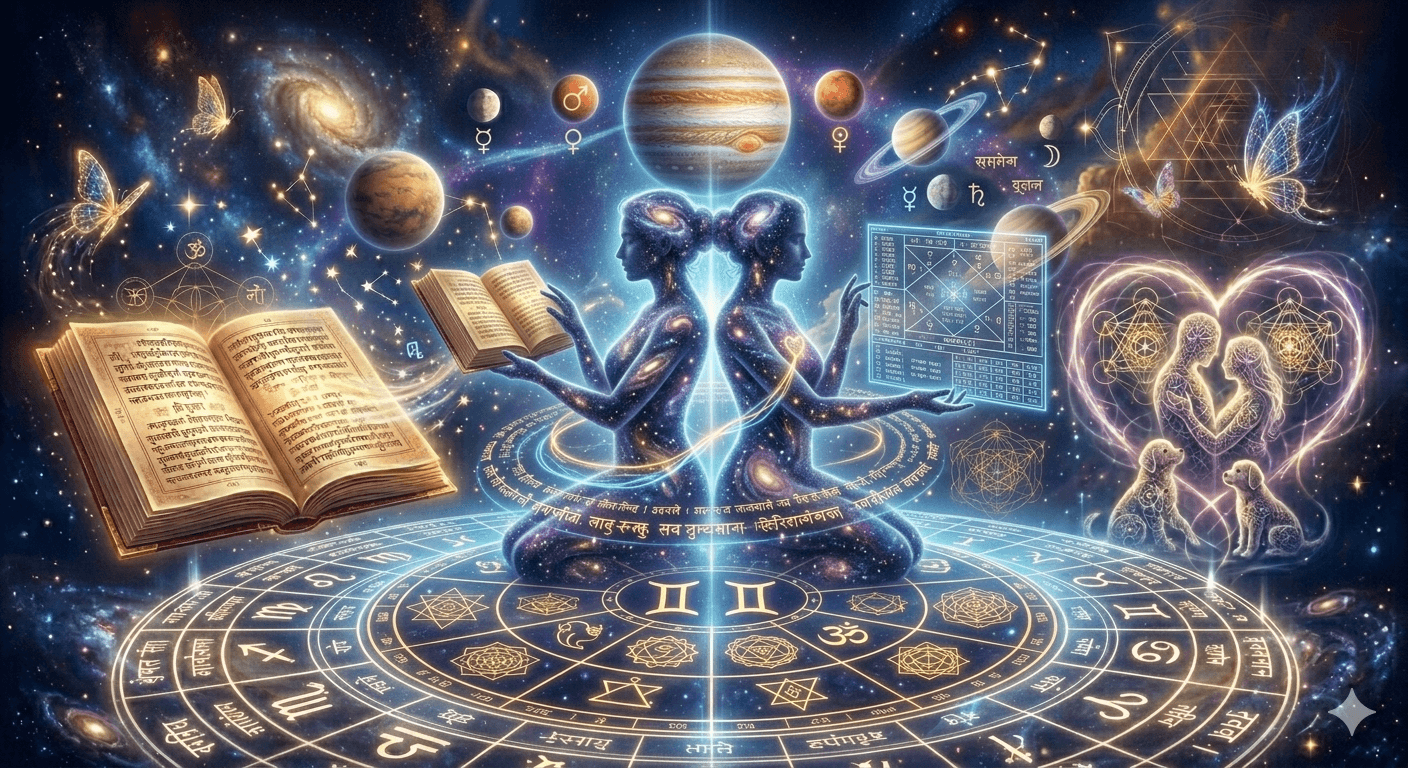
A Yoga in Vedic astrology is a specific planetary combination — a meeting of planets in particular signs, houses, or angular relationships — that produces a predictable set of outcomes in the native's life. The word Yoga means "union" in Sanskrit, and that is precisely what these combinations represent: the merging of two or more planetary energies in a configuration that amplifies, modifies, or transforms their individual significations into something distinct.
Classical Vedic texts catalogue hundreds of Yogas. Many are obscure or applicable to only a small fraction of charts. This guide focuses on the most significant and commonly occurring ones — the Yogas a working astrologer looks for first in any birth chart reading.
How Yogas Form
Yogas form through three primary mechanisms:
Conjunction: Two or more planets in the same sign create a conjunction Yoga. The most powerful conjunctions involve the lords of angular houses (1st, 4th, 7th, 10th) or trine houses (1st, 5th, 9th) connecting with each other.
House lordship exchange: When the lord of house A is placed in house B and the lord of house B is placed in house A, a Parivartana Yoga (exchange) is formed. This creates a powerful connection between two life areas.
Special positional combinations: Some Yogas require specific sign placements — exaltation, own sign, or specific house positions — to activate.
An important caveat that separates serious Jyotish from popular astrology: the strength of a Yoga is always modified by the overall condition of the planets involved. A Jupiter-Moon Yoga (Gajakesari) is powerful when both planets are well-placed, unafflicted, and operating in strong Dashas. The same Yoga with both planets combust, debilitated, or hemmed by malefics may produce minimal results. The Yoga's presence in the chart establishes potential; the Dasha activates it. For Dasha context: Your Dasha Period Is Running Your Life Right Now.
Raja Yogas — Combinations for Power and Authority
Raja Yoga literally means "royal combination." In classical Vedic astrology it referred to combinations that could produce royalty — but in the modern context it indicates significant achievement, authority, public recognition, and the ability to lead or influence at scale.
The classical definition: a Raja Yoga forms when the lord of a Kendra (angular house: 1st, 4th, 7th, 10th) and the lord of a Trikona (trine house: 1st, 5th, 9th) conjoin, mutually aspect, or exchange houses. Because the 1st house is simultaneously a Kendra and a Trikona, the Ascendant lord is always an important Raja Yoga trigger.
Examples by Ascendant:
- Aries Ascendant: Saturn (10th lord, Kendra) + Jupiter (9th lord, Trikona) conjunction or exchange = powerful Raja Yoga for career and dharmic authority
- Cancer Ascendant: Mars (10th lord, Kendra) + Jupiter (9th lord, Trikona) = Raja Yoga connecting career with higher purpose
- Leo Ascendant: Mars (9th lord, Trikona) + Venus (10th lord, Kendra) = Raja Yoga for wealth and status through creative or artistic achievement
The strongest Raja Yogas involve the 9th and 10th lords — dharma (purpose) meeting karma (action) — which is why they are associated with meaningful public achievement rather than mere fortune.
Dhana Yogas — Wealth Combinations
Dhana Yogas are combinations that produce material wealth and financial prosperity. They form through connections between the wealth-indicating houses: the 2nd (accumulated wealth), 5th (speculation and earned gains), 9th (fortune and grace), and 11th (income and large gains).
A powerful Dhana Yoga forms when the 2nd and 11th lords are conjunct, exchange houses, or aspect each other — especially when this occurs in a Kendra or Trikona. Jupiter as the natural significator of wealth, when strong and aspecting the 2nd or 11th house, also produces Dhana Yoga effects. The strength of the Dhana Yoga is always assessed against the Ascendant lord's condition — overall chart strength is required for wealth Yogas to fully manifest.
The Pancha Mahapurusha Yogas — Five Great Person Combinations
The Pancha Mahapurusha Yogas are five specific Yogas, each produced by one of the five visible planets (Mars, Mercury, Jupiter, Venus, Saturn) being in its own sign or exaltation sign in a Kendra (angular house). Each produces a distinct type of exceptional person:
| Yoga Name | Planet | Condition Required | Core Qualities Produced |
|---|---|---|---|
| Ruchaka | Mars | Mars in Aries, Scorpio, or Capricorn in a Kendra | Physical strength, military prowess, courage, leadership, commanding presence |
| Bhadra | Mercury | Mercury in Gemini or Virgo in a Kendra | Exceptional intellect, communication mastery, analytical precision, business acumen |
| Hamsa | Jupiter | Jupiter in Cancer, Sagittarius, or Pisces in a Kendra | Wisdom, righteousness, spiritual authority, teaching ability, grace |
| Malavya | Venus | Venus in Taurus, Libra, or Pisces in a Kendra | Aesthetic refinement, artistic mastery, charisma, luxury, profound love nature |
| Shasha | Saturn | Saturn in Capricorn, Aquarius, or Libra in a Kendra | Discipline, longevity, authority, management of large organisations, endurance |
Having one of these Yogas in your chart is significant. Having two or more is rare and indicates genuine exceptional potential in those combined domains. The Yoga must be active in the relevant Mahadasha and Antardasha to fully express.
Gajakesari Yoga — Elephant and Lion
Gajakesari Yoga (from Sanskrit: Gaja = elephant, Kesari = lion) is one of the most celebrated and widely occurring benefic Yogas. It forms when Jupiter is in a Kendra (1st, 4th, 7th, or 10th house) from the Moon.
The Moon and Jupiter together represent the two great benefics of the Vedic system — the Moon governing emotional intelligence and Jupiter governing wisdom and grace. When they form a Kendra relationship, they support each other's significations powerfully. Gajakesari Yoga is associated with intellectual brilliance, good reputation, material prosperity, emotional stability, and a broadly fortunate life trajectory.
Because Jupiter takes approximately 12 years to orbit the Sun, it spends roughly one year in each sign. The Moon, moving through all signs in 28 days, is in a Kendra from Jupiter's position for approximately 10 days of every month. This means Gajakesari Yoga is present in roughly one-third of all birth charts — which is why Vedic astrologers assess its strength carefully rather than simply noting its presence. Jupiter and the Moon must both be well-placed, unafflicted, and in signs where they are comfortable for the Yoga to produce strong results.
Kemadruma Yoga — The Isolated Moon
Kemadruma Yoga is a challenging combination formed when the Moon has no planets in the signs immediately before it (2nd from Moon) or immediately after it (12th from Moon) — leaving the Moon entirely isolated. It is associated with emotional instability, difficulty in maintaining consistent relationships, financial irregularity, and a sense of being unsupported or alone in one's endeavours.
However, Kemadruma Yoga is cancelled (Kemadruma Bhanga) by several conditions: a planet in a Kendra from the Moon, a planet in a Kendra from the Ascendant, the Moon being full or nearly full, or the Moon being in a Kendra from the Ascendant itself. Many charts that nominally have Kemadruma are actually significantly mitigated by these cancellation conditions. The presence of the Yoga should be assessed for cancellations before interpreting its effects.
Neecha Bhanga Raja Yoga — Debilitation Cancelled Into Strength
One of the most counterintuitive Yogas in Jyotish: Neecha Bhanga Raja Yoga forms when a planet's debilitation is cancelled by specific conditions, converting what would have been weakness into unusual strength. The core principle is that a planet that falls into its lowest point and then recovers possesses a particular resilience and depth that a continuously well-placed planet may lack.
Debilitation is cancelled when: the lord of the sign where the planet is debilitated is in a Kendra from the Ascendant or Moon; or the planet that would be exalted in that sign is in a Kendra from the Ascendant or Moon; or the debilitated planet itself is in a Kendra from the Ascendant or Moon; or the debilitated planet and its dispositor are in mutual Kendra.
A classic example: Saturn is debilitated in Aries. If Mars (lord of Aries) is simultaneously in a Kendra from the Ascendant, Saturn's debilitation is cancelled and the combination becomes a Raja Yoga. This is associated with extraordinary resilience — the ability to build strength precisely from adversity.
How to Spot Yogas in Your Own Chart
Start by identifying your Ascendant sign from your birth chart. From your Ascendant, determine which planets rule the Kendra houses (1, 4, 7, 10) and which rule the Trikona houses (1, 5, 9). Any conjunction, exchange, or mutual aspect between a Kendra lord and a Trikona lord is a Raja Yoga of some kind. The house where this conjunction or exchange occurs, and the planets involved, describe which life area the Yoga primarily activates.
Check your Jupiter position relative to your Moon for Gajakesari. Check whether any of the five classical planets (Mars, Mercury, Jupiter, Venus, Saturn) are in their own sign or exaltation in a Kendra for the Pancha Mahapurusha Yogas. Then check your current Dasha period to see which planet's themes are active right now — if that planet is part of a strong Yoga, this period is likely to be one of its most significant activations.
The Navamsa chart confirms whether the Yoga's promise will be fulfilled — see the full treatment in: Navamsa Chart — The Soul and Marriage Map.