
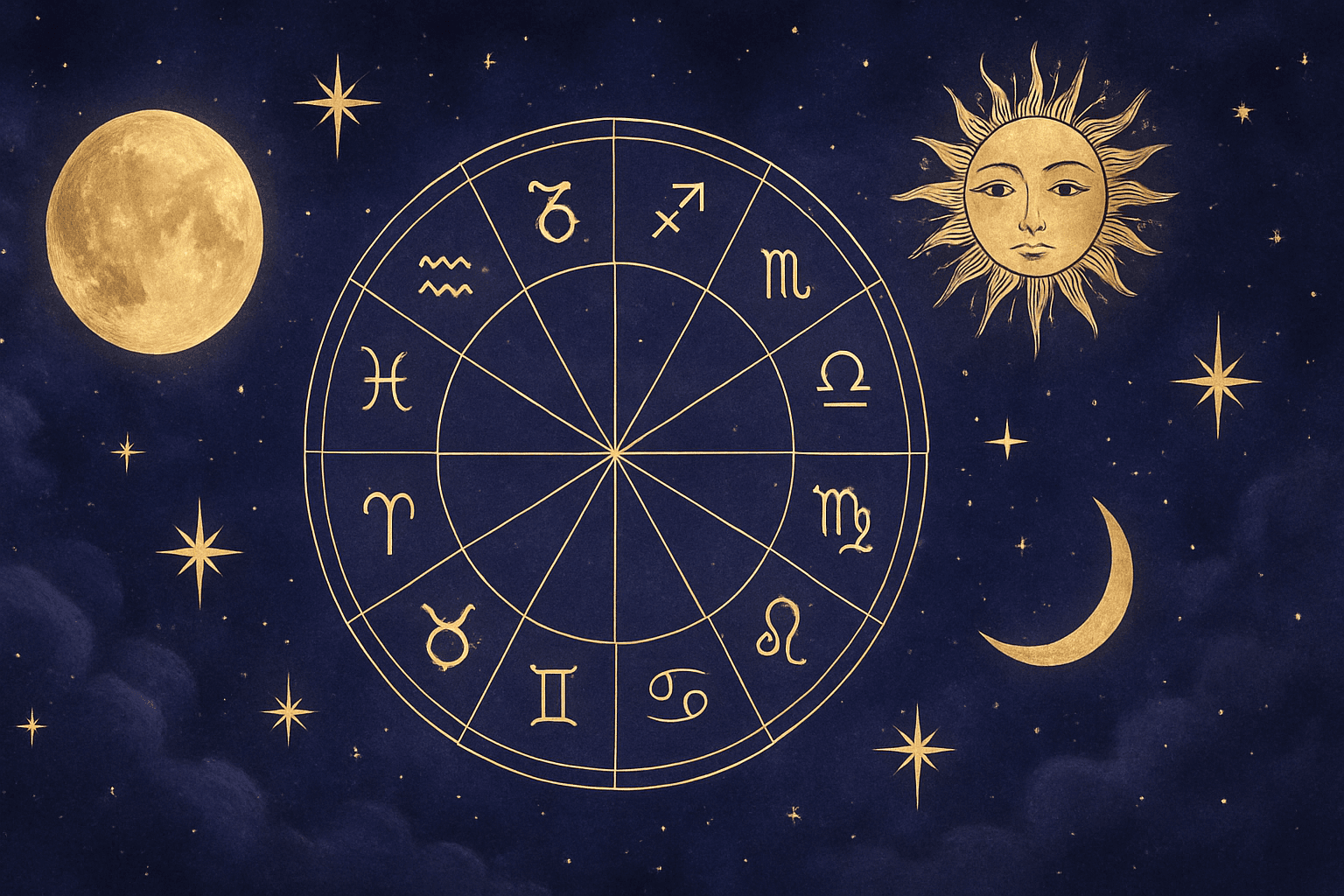
You know your Sun sign. Maybe you've looked up your Moon and Rising. But every time someone mentions "my Venus is in the 8th house" or "I have a packed 10th house," the conversation suddenly feels like it's in a different language. Here's the thing: signs tell you how energy expresses itself, but houses tell you where it shows up in your actual life — your money, your relationships, your career, your secrets. Without houses, a birth chart is a painting with no frame.
To see which planets land in which houses in your own chart, you'll need your birth time. Run your full natal chart first, then use the house placements calculator to get a focused breakdown. Once you have that map in front of you, this guide will tell you exactly what you're looking at.
How the House System Works
Think of the 12 houses as a wheel divided into 12 slices, each governing a specific department of life. The wheel starts at the eastern horizon — your Ascendant, or Rising sign — and moves counterclockwise. Your Ascendant sign sets the entire house structure: shift the birth time by even a few minutes, and planets can slide into different houses entirely. That's why astrologers insist on an accurate birth time.
In Western astrology, the most popular house systems are Placidus and Whole Sign. In Vedic (sidereal) astrology, Whole Sign houses are the standard, and the system is called Bhava. The underlying logic is the same: each house number corresponds to a life theme, and any planet sitting in that house colors that theme with its own energy.
Angular, Succedent, and Cadent
Houses are grouped into three qualities:
- Angular (1, 4, 7, 10): The power players. These are the most visible, action-oriented houses. Planets here hit hard and fast.
- Succedent (2, 5, 8, 11): Stabilizers. They consolidate what the angular houses initiate — think resources, pleasure, shared assets, community.
- Cadent (3, 6, 9, 12): Adapters. Mental and mutable in nature — communication, service, philosophy, and the unseen.
All 12 Houses at a Glance
| House | Traditional Name | Life Area | Natural Sign Ruler | Quality |
|---|---|---|---|---|
| 1st | House of Self | Identity, appearance, first impressions | Aries | Angular |
| 2nd | House of Possessions | Money, values, self-worth | Taurus | Succedent |
| 3rd | House of Communication | Siblings, short trips, learning style | Gemini | Cadent |
| 4th | House of Home | Family, roots, private life, real estate | Cancer | Angular |
| 5th | House of Pleasure | Romance, creativity, children, fun | Leo | Succedent |
| 6th | House of Service | Health, daily routines, work environment | Virgo | Cadent |
| 7th | House of Partnerships | Marriage, contracts, open enemies | Libra | Angular |
| 8th | House of Transformation | Shared resources, death, rebirth, intimacy | Scorpio | Succedent |
| 9th | House of Philosophy | Higher education, travel, belief systems | Sagittarius | Cadent |
| 10th | House of Career | Public image, ambition, legacy | Capricorn | Angular |
| 11th | House of Community | Friends, networks, hopes, social causes | Aquarius | Succedent |
| 12th | House of the Unconscious | Solitude, spirituality, hidden enemies, karma | Pisces | Cadent |
House-by-House Deep Dive
1st House — The House of Self
This is you — your body, your vibe, the energy you radiate when you walk into a room. The sign on the cusp of the 1st house is your Ascendant, and it shapes your physical appearance, mannerisms, and instinctive approach to life more than almost any other placement. Planets here dominate your personality. Mars in the 1st? You lead with fire and directness. Neptune in the 1st? People project their fantasies onto you. Check your Ascendant sign to see what's ruling your 1st house.
2nd House — The House of Possessions
Money, material security, and what you fundamentally value. The 2nd house isn't just about bank accounts — it's about self-worth. Venus here often signals someone who attracts resources easily; Saturn here can mean you earn every dollar the hard way but build wealth that lasts. In Vedic astrology, this house also governs speech and family wealth (called Dhana Bhava).
3rd House — The House of Communication
How you think, write, speak, and process daily information. This house also covers siblings, neighbors, and short-distance travel. A busy 3rd house often shows up in writers, teachers, and people who always have six tabs open. Your Mercury sign pairs naturally with this house — Mercury is communication's planet, and the 3rd house is its home turf.
4th House — The House of Home
Your roots, your parents (traditionally the mother or the more nurturing parent), your childhood conditioning, and the physical home you create as an adult. The 4th house is the very bottom of the chart — the most private point. Planets here often describe your emotional foundation. Moon in the 4th is deeply intuitive and attached to home; Uranus in the 4th can signal an unconventional or disrupted childhood. Use the Moon sign calculator to explore this emotional layer further.
5th House — The House of Pleasure
Romance (not marriage — that's the 7th), creative self-expression, children, hobbies, gambling, and anything you do purely for the joy of it. The 5th house is where you play. If your Venus sign lands here, love affairs tend to be dramatic and central to your story. Jupiter here often indicates luck in speculation and a generous, warm relationship with children.
6th House — The House of Service
Daily work (not career ambition — that's the 10th), health habits, routines, and acts of service. This is the "gym membership and to-do list" house. Planets here shape how you handle responsibility on a Tuesday afternoon. A stellium in the 6th often creates someone deeply devoted to their craft — or someone who burns out trying to perfect everything. In Vedic astrology, the 6th is also the house of enemies, debts, and disease (Ripu Bhava), but overcoming these obstacles here builds tremendous resilience.
7th House — The House of Partnerships
Marriage, business partnerships, contracts, and — interestingly — open enemies (people who challenge you face-to-face). The 7th house sits directly opposite the 1st, so it represents "the other" — what you seek in a partner and what you project outward. Want to see how your chart interacts with someone else's? The compatibility calculator compares both charts across house overlays and aspects.
8th House — The House of Transformation
Shared finances (your partner's money, taxes, inheritance, debt), deep intimacy, psychological transformation, death, and rebirth. The 8th house is where ego goes to die so something truer can emerge. Pluto or Scorpio energy here amplifies the intensity tenfold. This house also governs occult interests and research into hidden things — if you've always been drawn to astrology itself, check whether you have 8th-house placements.
9th House — The House of Philosophy
Higher education, long-distance travel, religion, law, publishing, and your personal belief system. While the 3rd house is about absorbing information, the 9th is about synthesizing it into meaning. Jupiter is the natural ruler here, and a strong 9th house often shows up in scholars, travelers, and spiritual seekers. In Vedic astrology, the 9th is Dharma Bhava — the house of your life's purpose and your relationship with your father or guru.
10th House — The House of Career
Public reputation, career trajectory, authority, and legacy — what the world remembers you for. The cusp of the 10th house is your Midheaven (MC), one of the most career-relevant points in the chart. Run your Midheaven sign to see which sign rules your 10th house cusp and what it says about your professional path. Saturn here builds slowly but earns lasting respect; Sun here craves public recognition.
11th House — The House of Community
Friendships, social networks, collective goals, humanitarian causes, and your long-term hopes and wishes. The 11th house is where personal ambition (10th) meets the group — think activist circles, professional networks, online communities. Planets here describe the kind of friends you attract and the role you play in groups. Uranus here is the revolutionary; Venus here is the social glue.
12th House — The House of the Unconscious
Solitude, dreams, spirituality, self-undoing, hidden enemies, institutions (hospitals, prisons), and karmic debts from past lives. The 12th house is the hardest to access because it operates below conscious awareness. A well-aspected 12th house can produce deep spiritual gifts, artistic inspiration, and profound compassion. A stressed 12th house can manifest as escapism, addiction, or chronic self-sabotage. Your North Node and South Node can reveal which karmic patterns play out through this house.
Empty Houses: Should You Worry?
Most people have several houses with no planets in them. That's completely normal — there are 10 traditional celestial bodies and 12 houses, so at least two will always be empty (and usually more). An empty house doesn't mean that area of life is absent or doomed. It simply means that department runs on autopilot, governed by the sign on the cusp and its ruling planet. For example, if your 7th house is empty but has Sagittarius on the cusp, Jupiter's placement elsewhere in your chart will describe how partnerships unfold for you.
Houses in Vedic vs. Western Astrology
In both systems, the 12 houses govern the same life themes. The key differences are:
- Zodiac framework: Western astrology uses the tropical zodiac (tied to seasons), while Vedic uses the sidereal zodiac (tied to fixed stars). This means your house cusps can shift by roughly 23–24 degrees between systems.
- House system: Vedic astrology almost always uses Whole Sign houses. Western astrologers often use Placidus, Koch, or Equal houses.
- Timing: Vedic astrology layers the Vimshottari Dasha system on top of houses to predict when a particular house theme will activate in your life — something Western astrology addresses mainly through transits and progressions.
Our calculators support both systems using the Swiss Ephemeris, so you can compare your house placements side by side.
How to Start Reading Your Houses
- Pull your chart. Use the birth chart calculator with your exact birth time.
- Check your house placements. The house placements tool lists every planet and its house position.
- Identify clusters. Three or more planets in one house (a stellium) signal a major life theme. That area of life will demand your attention repeatedly.
- Read the ruler. For empty houses, find the ruling planet of the sign on the cusp and see which house that planet occupies. It creates a link between those two life areas.
- Layer in aspects. A planet in a house doesn't act alone — its major aspects to other planets modify how smoothly or roughly that house theme plays out.
Frequently Asked Questions
Do I need my birth time to find my houses?
Yes. Without an accurate birth time, house cusps can't be calculated because the Ascendant — which sets the entire house wheel — changes roughly every two hours. If you don't have a birth time, you can still use a chart snapshot for sign-level placements, but house positions will be unknown.
What does it mean to have a stellium in one house?
A stellium (three or more planets in a single house) concentrates a lot of energy in one life area. It makes that house's themes unusually prominent — sometimes to the point where other areas feel neglected. A 10th-house stellium, for instance, often produces someone intensely focused on career and public standing.
Is the house system different in Vedic astrology?
The 12 houses govern the same themes in both traditions, but Vedic astrology uses the sidereal zodiac and Whole Sign houses, which can shift your placements compared to the Western tropical chart. Vedic astrology also uses the Dasha system to time when specific house themes activate.
What's the difference between the 6th house and the 10th house for career?
The 6th house governs your day-to-day work — tasks, routines, and service. The 10th house governs your career trajectory, public reputation, and long-term ambition. Someone can have a demanding 6th-house job that differs completely from their 10th-house calling.
Why do some astrologers use different house systems?
Different house systems (Placidus, Whole Sign, Koch, Equal) use different mathematical methods to divide the ecliptic. Each has strengths: Placidus is popular in modern Western astrology for its sensitivity to latitude, while Whole Sign is valued for its simplicity and its roots in Hellenistic and Vedic traditions. The best approach is to test both and see which resonates with your lived experience.
Bottom Line
The 12 houses are the scaffolding of your entire birth chart. Signs give planets a style; houses give them an address. Once you know where your planets live, you stop reading generic horoscopes and start reading your life. Pull up your house placements now and walk through each one with this guide open — you'll be surprised how much of your story the chart already knows.