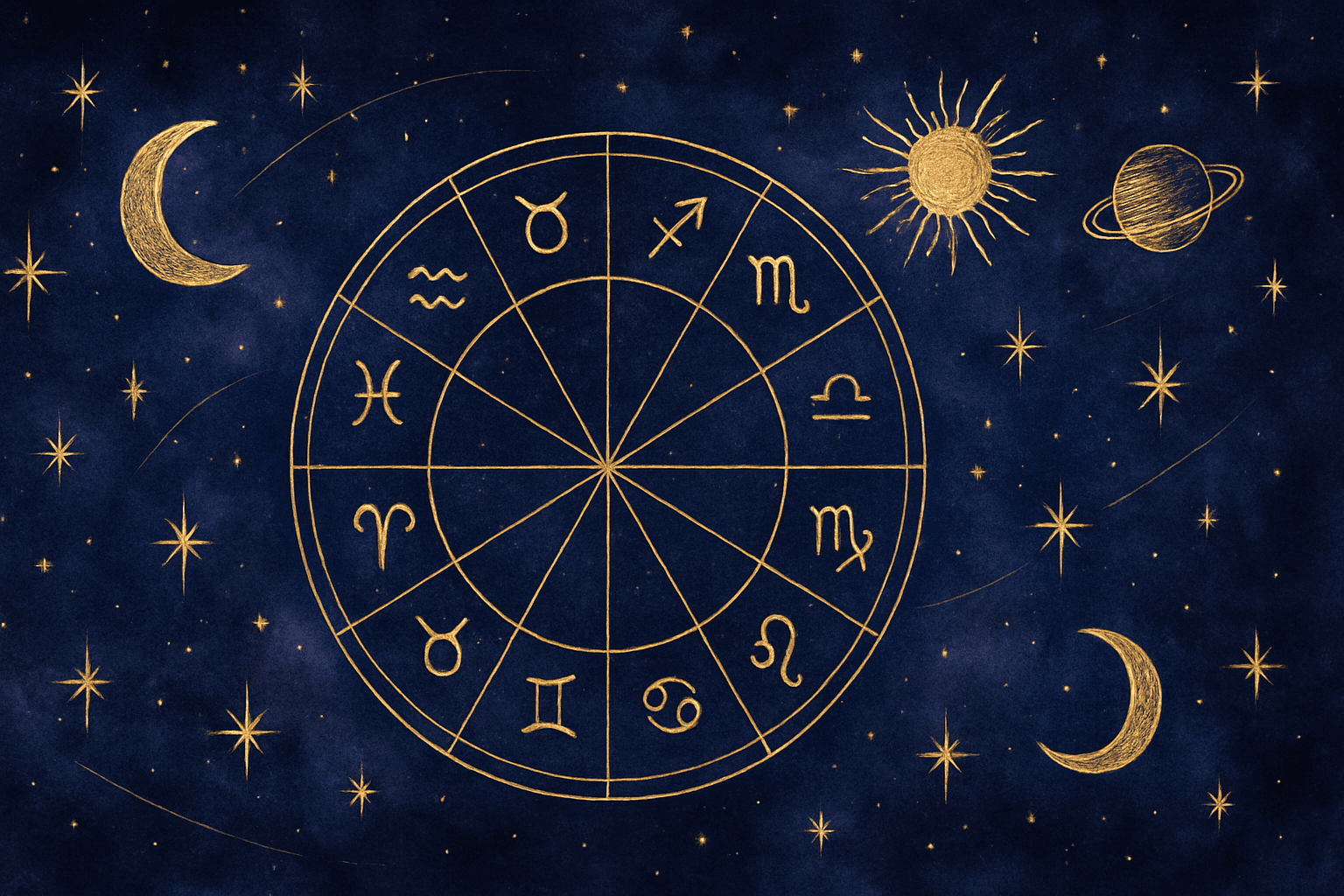
You pulled up your birth chart for the first time and it looks like someone threw a protractor at a pizza. Lines everywhere, weird symbols, numbers you don't recognize. You're not alone — this is the exact moment most people close the tab and go back to reading their Sun sign horoscope.
Don't do that. A birth chart is the single most detailed map astrology can give you, and once you know the basic building blocks, it's genuinely not that hard to read. Start by generating yours with our birth chart calculator — you'll need your date, time, and place of birth. If you don't have an exact birth time, our chart snapshot tool gives you a solid overview of your key placements without one.
What Exactly Is a Birth Chart?
A birth chart (also called a natal chart) is a snapshot of the sky at the precise moment you were born, viewed from the exact location of your birth. It maps where every planet sat in the zodiac and which segment of the sky — called a house — each planet occupied. Think of it as a cosmic fingerprint: no two are identical unless two people were born at the same time, in the same place, down to the minute.
Both Western (tropical) and Vedic (sidereal) astrology use birth charts, though they calculate zodiac positions slightly differently. Western astrology anchors the zodiac to the seasons; Vedic astrology anchors it to the fixed stars. The structure of the chart — planets, signs, houses, aspects — is the same in both systems. Everything in this guide applies to either tradition.
Step 1: Learn the Three Big Placements
Before you try to interpret every symbol on the wheel, zoom in on the three placements that carry the most weight. These alone will tell you more about yourself than a year of generic horoscope columns.
Sun Sign — Your Core Identity
Your Sun sign is the zodiac sign the Sun occupied at your birth. It represents your ego, your conscious will, and the qualities you're growing into throughout your life. This is the sign most people already know — it's what you get when someone asks "What's your sign?" Use our Sun sign calculator to confirm yours.
Moon Sign — Your Emotional Core
The Moon moves through a new sign roughly every 2.5 days, so this placement is far more personal than your Sun. It governs your instincts, emotional reactions, and what you need to feel safe. If your Sun sign description never quite felt like "you," your Moon sign often fills in the missing piece.
Ascendant (Rising Sign) — Your Outer Layer
Your Ascendant is the zodiac sign that was rising on the eastern horizon at the moment of your birth. It changes roughly every two hours, which is why birth time matters so much. The Ascendant sets the entire house system of your chart and shapes first impressions — how you come across before people really know you. Find yours with the Ascendant calculator.
Step 2: Understand the Planets
Each planet in your chart represents a specific drive or function in your psyche. The sign a planet occupies tells you how that function expresses itself. The house it sits in tells you where in your life it plays out. Here's a quick reference:
| Planet | What It Rules | Speed Through the Zodiac | Personal vs. Generational |
|---|---|---|---|
| Sun | Identity, ego, vitality | ~1 sign per month | Personal |
| Moon | Emotions, instincts, comfort | ~1 sign every 2.5 days | Personal |
| Mercury | Thinking, communication, learning | ~1 sign every 2-3 weeks | Personal |
| Venus | Love, beauty, values, money | ~1 sign every 3-4 weeks | Personal |
| Mars | Drive, anger, ambition, sexuality | ~1 sign every 6-7 weeks | Personal |
| Jupiter | Growth, luck, expansion, faith | ~1 sign per year | Social |
| Saturn | Discipline, limits, karma, mastery | ~1 sign every 2.5 years | Social |
| Uranus | Revolution, individuality, sudden change | ~1 sign every 7 years | Generational |
| Neptune | Imagination, illusion, spirituality | ~1 sign every 14 years | Generational |
| Pluto | Transformation, power, death/rebirth | ~1 sign every 12-31 years | Generational |
The personal planets (Sun through Mars) are where most of your unique personality shows up. You can explore each one individually — check your Mercury sign to understand how you think, your Venus sign for how you love, or your Mars sign for how you fight and pursue what you want.
Jupiter and Saturn are "social planets" — shared by everyone born within a year or two of you, but their house placement and aspects make them deeply personal. Our Jupiter sign calculator and Saturn sign calculator can help you identify where your growth and your hard lessons live.
Step 3: Learn the 12 Houses
If planets are the actors and signs are their costumes, houses are the stages they perform on. The 12 houses divide your chart into life areas. The Ascendant marks the cusp (starting edge) of the 1st House, and the rest follow counterclockwise around the wheel.
| House | Life Area | Key Themes |
|---|---|---|
| 1st | Self | Appearance, identity, first impressions |
| 2nd | Money & Values | Income, possessions, self-worth |
| 3rd | Communication | Siblings, short trips, learning style |
| 4th | Home & Family | Roots, parents, emotional foundations |
| 5th | Creativity & Romance | Joy, children, self-expression, dating |
| 6th | Health & Service | Daily routines, work habits, wellness |
| 7th | Partnerships | Marriage, business partners, open enemies |
| 8th | Transformation | Shared resources, intimacy, death/rebirth |
| 9th | Philosophy & Travel | Higher education, foreign cultures, belief systems |
| 10th | Career & Public Image | Reputation, ambition, authority (Midheaven cusp) |
| 11th | Community | Friends, groups, hopes, social causes |
| 12th | The Unconscious | Solitude, hidden strengths, self-undoing, spirituality |
You can use our house placements calculator to see exactly which planets land in each house of your chart. Pay special attention to any house with two or more planets — that life area is going to demand a lot of your attention.
The 10th House cusp is also known as the Midheaven (MC), and it's one of the most career-relevant points in the chart. If you're curious about yours specifically, the Midheaven calculator breaks it down.
Step 4: Read the Aspects
Aspects are the angular relationships between planets. They're those lines criss-crossing the center of your chart wheel. An aspect tells you whether two planets cooperate easily, create tension, or intensify each other. Here are the five major aspects you need to know:
Conjunction (0°) — Fusion
Two planets sitting on top of each other. Their energies merge. This is powerful and can go either way — constructive or overwhelming — depending on the planets involved.
Trine (120°) — Flow
An easy, harmonious connection. Talent and gifts live here, but trines can also make you lazy because things come without effort.
Square (90°) — Friction
Tension that forces action. Squares are uncomfortable, but they're the engine of growth. Most successful people have prominent squares in their charts.
Opposition (180°) — Polarity
Two planets pulling in opposite directions. Think tug-of-war. Oppositions demand balance and awareness of the "other side."
Sextile (60°) — Opportunity
Similar to a trine but milder. Sextiles offer doors — you just have to walk through them.
Our major aspects calculator will list every significant aspect in your chart along with the orb (how exact the angle is). Tighter orbs mean stronger aspects.
Step 5: Look at the Nodes and Special Points
Once you have the basics down, a few additional points add serious depth to your reading.
The North Node shows your karmic direction — the qualities your soul is learning to develop in this lifetime. The South Node (always directly opposite) represents what you've already mastered, possibly in past lives. These two points reveal your deepest growth arc. Check yours with the North Node calculator and South Node calculator.
Black Moon Lilith reveals your shadow side — the raw, untamed energy you might suppress or that society shames you for. It's not a physical body, but a mathematical point related to the Moon's orbit. Our Lilith sign calculator can pinpoint where yours falls.
The Part of Fortune is an Arabic lot calculated from your Sun, Moon, and Ascendant. It shows where luck and abundance flow most naturally in your chart. Find it with the Part of Fortune calculator.
Step 6: Tie It All Together
Reading a birth chart is not about interpreting each placement in isolation — it's about synthesis. Here's a practical sequence for putting it all together:
- Start with the Big Three (Sun, Moon, Ascendant). Write one sentence for each describing how its sign manifests.
- Check which houses are loaded. If your 7th house has three planets, relationships are a major life theme — period.
- Look at the chart ruler. The planet that rules your Ascendant sign is your chart ruler. Its sign, house, and aspects color your entire life story.
- Read the major aspects. Focus on conjunctions and squares first — they're the loudest.
- Note the element balance. Are most of your planets in fire signs (action-oriented), earth signs (practical), air signs (intellectual), or water signs (emotional)? A heavy lean tells you something.
If you practice Vedic astrology, layer in your Nakshatra (lunar mansion) and current Dasha period to see not just who you are, but what phase of life you're moving through right now.
Western vs. Vedic: Which Chart Should You Read?
Both systems are valid and time-tested. Western astrology uses the tropical zodiac and tends to focus on psychological insight — who you are, how you grow, what patterns you repeat. Vedic astrology uses the sidereal zodiac and the Vimshottari Dasha system, which excels at timing — when events are likely to unfold. Many experienced astrologers (including us at Swami) use both. Our birth chart calculator generates both tropical and sidereal charts from a single input, so you can compare them side by side.
Frequently Asked Questions
Do I need my exact birth time to read my chart?
For the full chart — including houses, Ascendant, and Midheaven — yes, birth time is essential. Without it, you can still identify your Sun, Moon (usually), Mercury, Venus, and Mars signs. Our chart snapshot is built specifically for people who don't have a precise birth time.
Why does my Vedic chart show different signs than my Western chart?
The tropical and sidereal zodiacs are offset by about 24 degrees (called the Ayanamsa). This means your Vedic placements may shift back by roughly one sign compared to your Western chart. Neither is "wrong" — they measure the sky differently.
What if I have an empty house — does that mean nothing happens there?
No. An empty house simply means no planet was in that sign at birth. The house is still active — you read it through the sign on its cusp and the ruling planet of that sign. Empty houses tend to be areas that run on autopilot rather than demanding constant attention.
Which placements matter most for relationships?
Venus, the Moon, the 7th House, and Mars are the biggest players in relationship astrology. For a detailed comparison between two people, run a compatibility reading or a full synastry chart.
How often should I re-read my birth chart?
Your birth chart never changes — it's fixed at the moment you were born. But your understanding of it deepens over time. Re-reading it every few months, especially during major transits or Dasha shifts, often reveals layers you missed before.
The Bottom Line
A birth chart is not a wall of mysterious symbols — it's a map with a clear legend. Planets are drives, signs are styles, houses are life areas, and aspects are relationships between those drives. Learn those four layers, and you can read any chart on Earth. Start with yours: pull up your full birth chart here, walk through each step in this guide, and see what clicks. You'll be surprised how quickly the pizza-with-a-protractor starts making sense.