
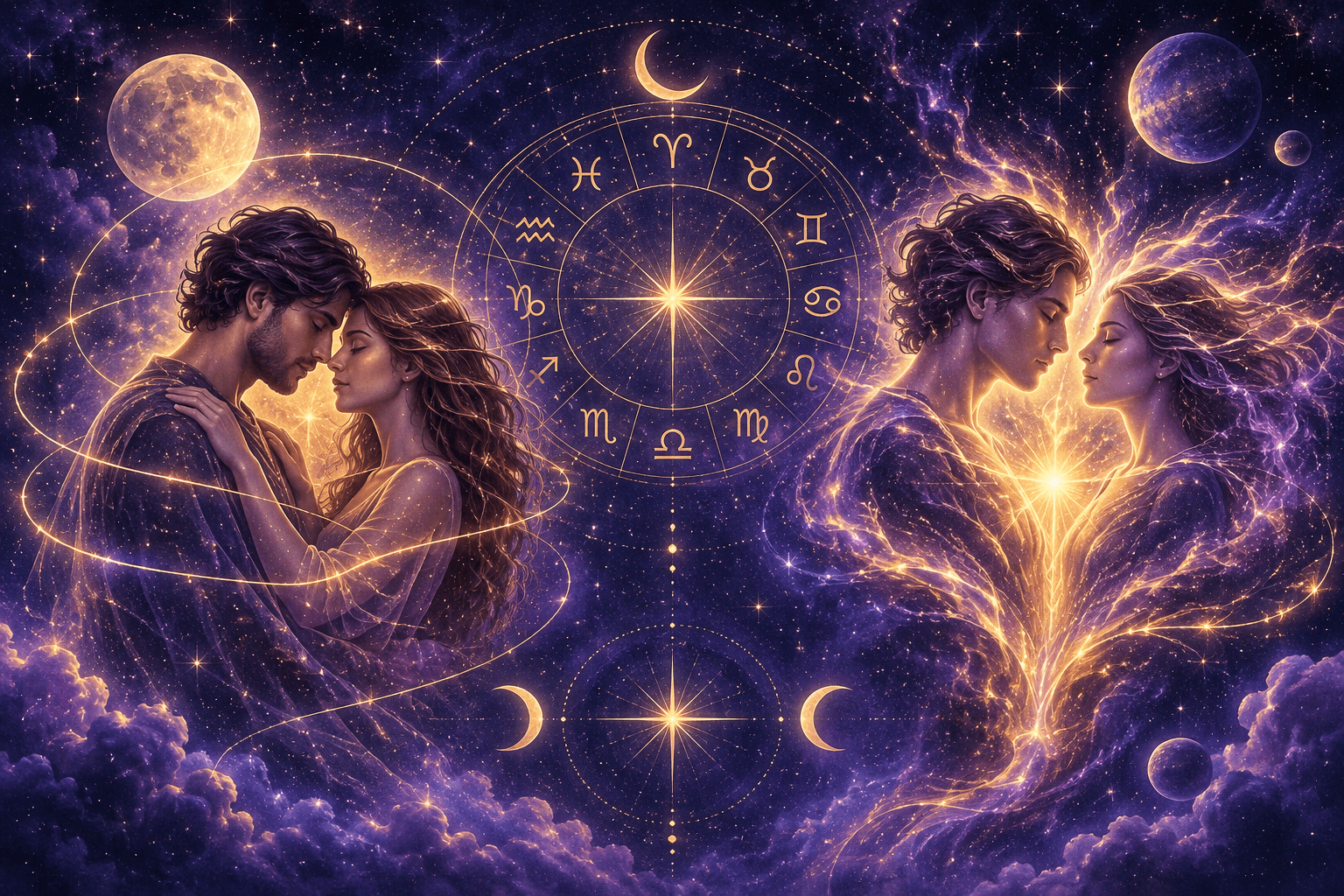
You've met someone who feels cosmically familiar. Maybe the connection was instant — a sense of recognition that bypassed logic entirely. But now you're trying to figure out what this actually is. Is this person your soulmate, here to build a life with? Or your twin flame, here to burn through every illusion you've been hiding behind? The internet will give you a hundred vague answers. Your synastry chart will give you a specific one.
The distinction matters because soulmate connections and twin flame connections demand completely different things from you. One tends to stabilize your life. The other tends to dismantle it — sometimes beautifully, sometimes painfully. Astrology doesn't just label the connection; it shows you the mechanics. The planets involved, the houses they land in, the aspects they form — these details tell you whether you're looking at deep soul recognition or a full-blown karmic mirror. Let's break down exactly what to look for.
What Astrologers Actually Mean by "Soulmate" and "Twin Flame"
Before we touch the chart, let's get the definitions straight. In astrological tradition, these aren't interchangeable buzzwords — they describe fundamentally different relationship blueprints.
The Soulmate Blueprint
A soulmate is someone your soul has agreed to meet again. That agreement usually involves mutual growth, support, or the completion of unfinished karmic business. You can have many soulmates — friends, family members, lovers. The hallmark feeling is safety. You feel seen, understood, and held. In the chart, soulmate connections tend to involve harmonious aspects (trines, sextiles, conjunctions to benefics) and strong lunar or Venusian ties. The relationship feels like coming home.
The Twin Flame Blueprint
A twin flame, in esoteric and astrological thought, is described as a mirror of your own soul — the same energetic frequency split into two charts. The hallmark feeling is intensity, often mixed with chaos. You don't just feel seen; you feel exposed. Twin flame synastry tends to involve hard aspects (squares, oppositions, Pluto contacts), heavy nodal activation, and an almost uncanny chart mirroring. The relationship doesn't feel like home — it feels like a wrecking ball aimed at every wall you've built around yourself.
The Synastry Signatures: Soulmate vs. Twin Flame
When you run a compatibility reading and examine the synastry overlays, certain patterns emerge consistently in each type of connection. Here's a direct comparison of what to look for.
| Chart Feature | Soulmate Signature | Twin Flame Signature |
|---|---|---|
| Moon contacts | Moon conjunct Moon, Moon trine Venus — emotional ease | Moon square Pluto, Moon opposite Saturn — emotional triggers |
| Venus contacts | Venus conjunct Jupiter, Venus trine Mars — natural attraction | Venus square Pluto, Venus conjunct Uranus — obsessive or erratic pull |
| North Node | Soft aspects to personal planets — gentle growth | Conjunctions to Sun, Moon, or Ascendant — unavoidable karmic collision |
| South Node | Strong South Node contacts — past-life familiarity and comfort | Fewer South Node ties — this feels new, not nostalgic |
| Saturn | Saturn trine or sextile personal planets — long-term stability | Saturn conjunct or square personal planets — lessons through restriction |
| Pluto | Minimal Pluto involvement — lighter energetic footprint | Heavy Pluto aspects — transformation is non-negotiable |
| Chart mirroring | Some shared placements — compatible, not identical | Reversed or mirrored signs — your Ascendant is their Descendant, etc. |
| Overall feel | Supportive, nourishing, sustainable | Destabilizing, catalytic, often cyclical |
The Nodes Tell the Biggest Story
If you want one single indicator that separates these two types of connection, look at the lunar nodes. Run your North Node placement alongside your partner's chart, and pay close attention to any conjunctions within 3 degrees.
Soulmate Nodal Patterns
In soulmate synastry, the South Node is usually the star of the show. When someone's personal planet — especially their Moon or Venus — lands on your South Node, the familiarity is immediate and visceral. You feel like you've known them before, because karmically, you have. These connections carry warmth and ease. The risk is stagnation: South Node relationships can keep you comfortable but stuck in old patterns if neither person pushes the other toward growth.
Twin Flame Nodal Patterns
Twin flame connections tend to activate the North Node instead. When someone's Sun, Moon, or Ascendant conjuncts your North Node, the relationship pulls you toward your karmic future — the person you're supposed to become. This rarely feels easy. You'll be drawn to them magnetically, but the relationship will constantly challenge your comfort zone. If both people's North Nodes are activated by the other's chart, you're looking at a rare, high-voltage mutual evolution dynamic.
Pluto and Uranus: The Transformer and the Lightning Bolt
Two outer planets play oversized roles in distinguishing these connections.
Pluto in Twin Flame Synastry
Pluto contacts are the calling card of twin flame dynamics. When one person's Pluto conjuncts or squares the other's Moon, Sun, or Venus, the relationship triggers deep psychological transformation. You can't stay the same person you were before you met them — that's the whole point. These aspects create obsessive attraction, power struggles, and profound intimacy, often cycling through all three in a single week. Use the major aspects calculator to check for Pluto aspects in your own chart first; if you already have natal Pluto-Venus or Pluto-Moon aspects, you're wired for intensity and may attract twin flame dynamics more frequently.
Uranus in Twin Flame Synastry
Uranus contacts add unpredictability. When Uranus hits someone's Venus or Descendant, the relationship has an electric, on-again-off-again quality. You can't pin it down. The connection might feel like a lightning strike — sudden, overwhelming, and impossible to ignore. Soulmate connections rarely feature heavy Uranus involvement; they're too stable for that frequency.
House Overlays: Where the Connection Lives
The houses your partner's planets fall into in your chart tell you where you'll feel their influence most. Check your house placements and compare.
Soulmate Houses
Soulmate connections tend to light up the 4th house (home, emotional foundation), the 7th house (committed partnership), and the 11th house (friendship, shared vision). These are houses of belonging, security, and companionship. When someone's Venus or Jupiter lands in your 7th house, the relationship just works — there's natural compatibility and a sense that you fit into each other's lives without forcing it.
Twin Flame Houses
Twin flame connections gravitate toward the 1st house (identity), the 8th house (transformation, shared resources, sexuality), and the 12th house (the unconscious, hidden patterns, spiritual dissolution). The 12th house overlap in particular is a telltale twin flame marker. When someone's Sun or Moon lands in your 12th house, they access parts of you that you've hidden even from yourself. It's profoundly intimate and profoundly unsettling.
The Vedic Perspective: Nakshatras and Dasha Timing
Western synastry isn't the only lens here. Vedic astrology offers additional tools for distinguishing these connections.
Nakshatra Compatibility
In the Vedic tradition, your birth nakshatra — your Moon's specific lunar mansion — is used to assess relationship compatibility through the Ashtakoota system. High nakshatra compatibility scores (above 24 out of 36) often correlate with soulmate-type connections: stable, supportive, and aligned on the values that matter for daily life. Twin flame connections, interestingly, sometimes score low on traditional Vedic compatibility because they aren't designed for comfort — they're designed for transformation.
Dasha Period Timing
Your current Vimshottari Dasha period can explain when and why a particular connection has entered your life. Soulmates often appear during Jupiter or Venus Dasha periods — times of expansion, grace, and receptivity. Twin flames are more likely to arrive during Rahu, Ketu, or Saturn Dasha periods — times of karmic reckoning, disruption, and forced growth. If you met someone intense during a Rahu Mahadasha, astrology isn't surprised.
Can a Soulmate Become a Twin Flame (or Vice Versa)?
This is one of the most common questions, and the answer is nuanced. The chart doesn't change — the aspects are fixed at birth. But your experience of those aspects evolves as you grow. A relationship that starts as a stabilizing soulmate connection can deepen into twin flame territory if Pluto transits begin activating the synastry over time. Similarly, a twin flame connection can eventually settle into soulmate energy once both people have done the transformational work the chart demanded.
The chart shows potential. What you do with that potential — whether you lean into the growth or run from it — determines how the story unfolds.
Frequently Asked Questions
Can you have more than one twin flame?
Most astrological traditions say no — the twin flame is considered a singular energetic mirror. However, you can have multiple soulmates across different areas of life (romantic, platonic, familial), and some connections may carry twin-flame-like intensity without being true twin flames.
What's the single most important synastry aspect for soulmates?
Moon conjunct Moon or Moon conjunct Venus in synastry is widely considered the strongest soulmate indicator. These aspects create an effortless emotional understanding that makes the relationship feel fated and deeply comforting.
Do twin flames always end up together?
Not necessarily. Twin flame connections are about transformation, not necessarily about building a permanent partnership. Some twin flame pairs catalyze enormous growth in each other and then separate — and that's not a failure; it's the design.
Can I see soulmate or twin flame indicators in my natal chart alone?
Your natal chart shows your capacity for these connections. Heavy 7th and 8th house activity, strong nodal aspects, and Pluto contacts to personal planets suggest you're someone who attracts deeply fated relationships. Pull up your full birth chart to check for these patterns before even looking at synastry.
What if our synastry shows both soulmate and twin flame signatures?
This is more common than you'd think. Most real relationships are a blend — some areas of ease, some areas of friction. The overall balance tells you which energy dominates: if harmonious aspects outnumber hard ones and the South Node is more activated than the North, it leans soulmate. If Pluto and the North Node dominate, it leans twin flame.
Bottom Line
The difference between a soulmate and a twin flame isn't about which one is "better" — it's about what each connection is designed to do. Soulmates build. Twin flames break open. Your synastry chart holds the specific evidence: the Moon contacts, the nodal alignments, the Pluto aspects, the house overlays. Stop guessing based on how the relationship feels and start reading the actual planetary data. Run your full synastry chart with the person you're thinking about — the aspects will tell you exactly what kind of cosmic contract you signed.