
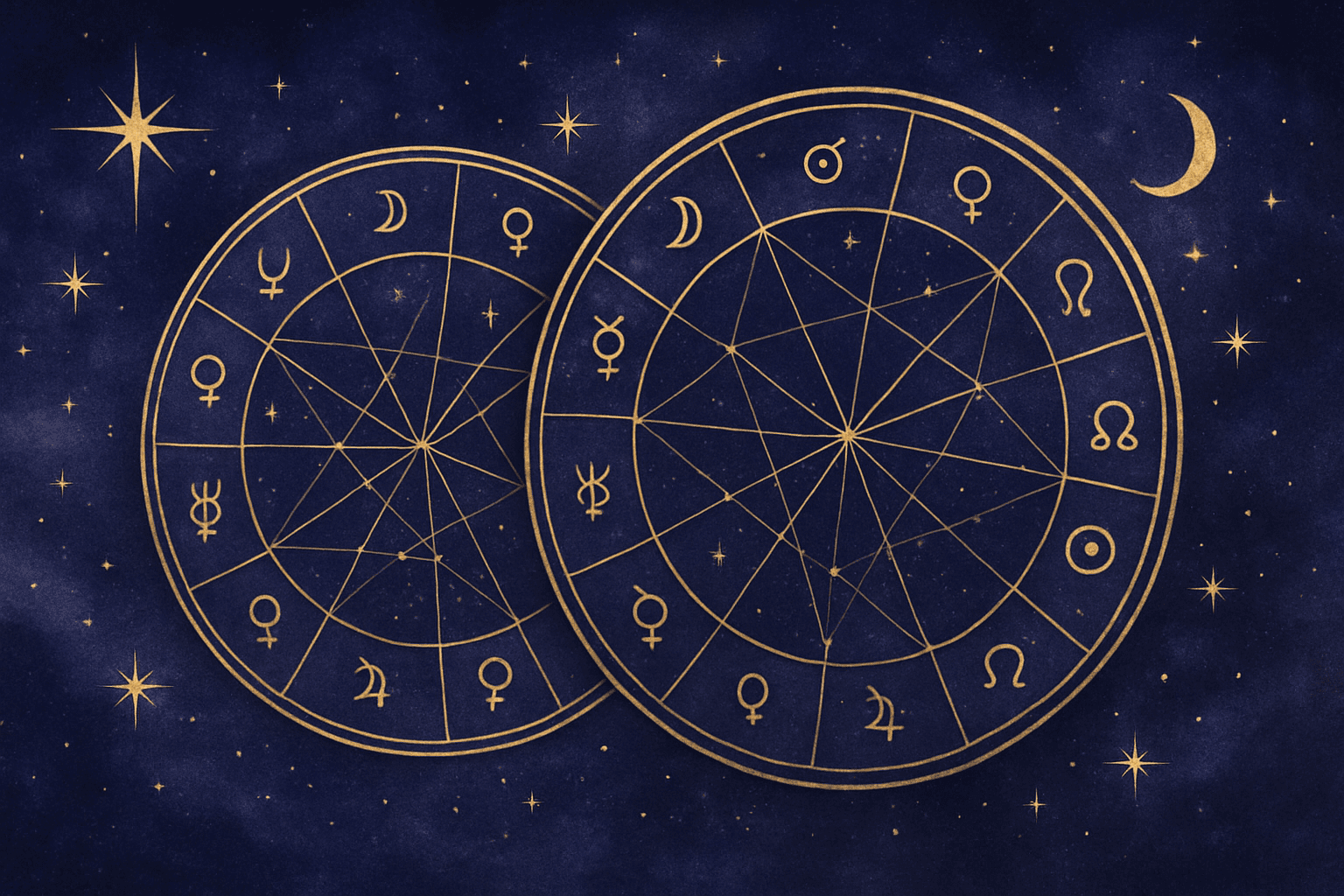
You've got chemistry with someone and you can't explain it. Conversations feel effortless. Or maybe the opposite — you're drawn to a person who drives you absolutely nuts, and you keep coming back anyway. Before you chalk it up to "vibes," there's a centuries-old technique that maps exactly where two people's energies merge, friction builds, and growth happens. It's called synastry, and it's the backbone of relationship astrology. If you've never run one, start with our full synastry chart calculator — it overlays both birth charts and flags every major connection.
Synastry isn't a pass/fail test. It doesn't spit out a score and tell you to stay or leave. What it does is show you the specific planetary conversations happening between two charts — so you can understand why certain dynamics exist and what to do about them. This guide breaks down the mechanics: how overlays work, which aspects matter most, and what to look for when you're reading your own synastry chart for the first time.
What Is a Synastry Chart, Exactly?
A synastry chart takes two individual birth charts — each calculated using date, time, and place of birth — and lays one on top of the other. It's not a new chart; it's a comparison. Your planets stay where they are. Their planets stay where they are. The magic is in the angles (aspects) that form between the two sets of planets and the houses where each person's planets land in the other person's chart.
Think of it this way: your natal chart is your internal wiring. Synastry shows what happens when your wiring plugs into someone else's system. Some connections light up the room. Others trip the breaker.
Synastry vs. Composite Charts
People often confuse these two. Synastry compares two separate charts. A composite chart mathematically merges them into one — it creates a single chart for the relationship itself. Both are useful, but synastry is where you start because it tells you how each person experiences the other. The composite tells you about the relationship as a third entity. For this guide, we're staying in synastry territory.
The Two Pillars of Synastry: Aspects and House Overlays
Every synastry reading comes down to two things: the aspects between the two charts' planets and the house overlays — where one person's planets fall in the other person's houses.
Planetary Aspects in Synastry
An aspect is the angular distance between two planets. In synastry, you're measuring the angle between a planet in Chart A and a planet in Chart B. The same five major aspects from natal astrology apply here — but the interpretations shift because you're dealing with two different people's energies interacting. If you're fuzzy on how aspects work in your own chart, our major aspects calculator is a good refresher.
| Aspect | Angle | Energy | What It Feels Like in Synastry |
|---|---|---|---|
| Conjunction (☌) | 0° | Fusion — amplified for better or worse | Intense recognition; you feel like the same frequency |
| Trine (△) | 120° | Flow — effortless harmony | Easy rapport; things click without trying |
| Sextile (⚹) | 60° | Opportunity — gentle support | Mutual encouragement; you bring out each other's strengths |
| Square (□) | 90° | Tension — friction that demands action | Attraction with irritation; push-pull dynamic |
| Opposition (☍) | 180° | Polarity — magnetic but challenging | Fascination with your differences; mirror effect |
A common mistake: assuming squares and oppositions are "bad." In synastry, squares create the heat and urgency that keeps relationships from going stale. A chart full of nothing but trines can feel comfortable but eventually boring — like a friendship that never deepens into anything more. The most compelling relationships usually have a mix.
House Overlays
This is the part most beginners skip, and it's arguably the most revealing layer of synastry. When your partner's Venus falls in your 4th house, they make you feel at home. When their Mars lands in your 10th house, they push your career ambitions — or compete with them. The house tells you which area of life that planet activates for you.
You need an accurate birth time for house overlays to work, because the house cusps shift roughly one degree every four minutes. If you know your birth time, our house placements calculator will show you exactly which houses are in play.
The Planets That Matter Most in Synastry
Every planet contributes something, but relationship astrology focuses on a specific hierarchy. Here's what to look at first, in order of importance.
The Moon: Emotional Compatibility
Forget Sun sign compatibility lists. The Moon is the real compatibility indicator. It governs your emotional needs, your attachment style, and what makes you feel safe. When your Moon makes a trine or conjunction to your partner's Sun, Venus, or Moon, you instinctively get each other on an emotional level. Squares between Moons can mean you need comfort in fundamentally different ways — not a dealbreaker, but something to navigate consciously. Run your Moon sign first so you know what you're working with.
Venus and Mars: Attraction and Desire
Venus-Mars aspects between two charts are the classic "sexual chemistry" indicators. Venus conjunct Mars? Magnetic. Venus square Mars? Magnetic and frustrating. These aspects show whether the way you love (Venus) and the way they pursue (Mars) are speaking the same language. Check your Venus sign and Mars sign to understand your own romantic wiring before reading the interplay.
The Sun: Identity and Mutual Respect
Sun-Sun aspects show whether your core identities support or clash with each other. Sun conjunct Sun means you share fundamental values but may compete for the spotlight. Sun opposite Sun (common in people born six months apart) creates fascination — you embody what the other person lacks. Sun-Moon aspects, especially the conjunction, sextile, and trine, are some of the strongest indicators of long-term compatibility in classical astrology.
Saturn: The Staying Power Planet
Saturn in synastry gets a bad reputation, but it's the glue. Saturn aspects to personal planets (Sun, Moon, Venus, Mars) indicate commitment, responsibility, and willingness to do the hard work. Without Saturn connections, relationships can be exciting but dissolve under pressure. With too many harsh Saturn aspects, one person may feel restricted or criticized by the other. Balance is key. You can check your Saturn sign to understand how you handle responsibility in relationships.
The Nodes: Karmic Connections
When one person's planets — especially the Sun, Moon, or Venus — conjunct the other person's North or South Node, there's often a "fated" feeling. South Node contacts suggest familiarity, like you've known each other before. North Node contacts suggest this person pushes you toward growth. These are powerful but not always comfortable. Explore your own North Node to understand where your soul is headed.
How to Read Your Synastry Chart: A Step-by-Step Approach
When you pull up a synastry chart for the first time, the grid of aspects can look overwhelming. Here's a practical order of operations:
Step 1: Identify the tightest aspects. An aspect with a 1° orb is far more potent than one at 8°. Start with the closest connections — those are the ones you'll feel most viscerally.
Step 2: Count the aspect types. Tally the conjunctions, trines, sextiles, squares, and oppositions. A heavy lean toward one type tells you the overall texture of the relationship. Mostly squares? Expect passion and growth through conflict. Mostly trines? Easy compatibility, less drama.
Step 3: Check the luminaries. Look specifically at Sun-Moon, Moon-Moon, and Sun-Sun aspects. These form the emotional and identity backbone of the connection.
Step 4: Examine Venus-Mars interaspects. These reveal romantic and sexual chemistry.
Step 5: Look at house overlays. Where do their planets land in your chart? A cluster in your 7th house (partnerships) or 5th house (romance) is significant. A cluster in your 12th house is intense and potentially confusing — hidden dynamics, spiritual bonds, or both.
Step 6: Note Saturn and Nodal contacts. These speak to longevity and karmic purpose.
If you want the quick version without all the manual work, our compatibility calculator highlights the most significant aspects and overlays automatically.
What Synastry Can't Tell You
Synastry shows potential, not destiny. A "perfect" synastry chart doesn't save a relationship where one person won't communicate. A challenging chart doesn't doom two people who are committed to working through their stuff. The chart is a map — you still have to drive.
It also can't account for where each person is in their own growth. A Saturn-Moon square between two emotionally mature adults plays very differently than the same aspect between two people in their early twenties who haven't done any inner work. Context always matters.
The Vedic Angle: Synastry in Jyotish
In Vedic astrology, compatibility is traditionally assessed through a system called Ashtakoota, which compares the Moon's nakshatra (lunar mansion) of both partners across eight categories. This system assigns points — a maximum of 36 — and is still widely used for marriage matching in South Asian cultures. While Ashtakoota is more structured than Western synastry, both systems ultimately focus on the same core question: how do these two energies interact?
If you're curious about your Vedic timing, knowing your current Dasha period adds context — a Venus Dasha, for instance, naturally brings relationship themes to the foreground, making synastry insights especially relevant.
Frequently Asked Questions
Do I need an exact birth time for a synastry chart?
You need an accurate birth time for house overlays and the Ascendant. Without it, you can still read planet-to-planet aspects, which carry the bulk of the compatibility information. If you don't know your birth time, try our chart snapshot calculator for a time-free overview.
What's the difference between synastry and a compatibility reading?
Synastry is the technical method — overlaying two charts. A compatibility reading interprets that synastry data and may also include composite chart analysis. Our compatibility calculator gives you an interpreted version of the raw synastry data.
Which single aspect is the strongest indicator of lasting love?
Most traditional astrologers point to Sun conjunct Moon (or Moon conjunct Sun) in synastry — it represents a deep integration of identity and emotional needs. But no single aspect makes or breaks a relationship; the full pattern matters.
Can synastry work for friendships, family, or business partners?
Absolutely. Synastry applies to any two-person relationship. For business, focus on Mercury aspects (communication), Saturn contacts (structure), and 10th house overlays (career impact). For family, Moon and 4th house connections are especially revealing.
Are "difficult" synastry aspects always bad?
No. Squares and oppositions create attraction, growth, and dynamic energy. Many deeply bonded couples have significant squares in their synastry. The key is whether both people are willing to work with the friction constructively.
Bottom Line
Synastry is astrology's most precise tool for understanding what happens between two people — not in generic terms, but planet by planet, house by house, degree by degree. It shows where you harmonize, where you challenge each other, and where the real growth lives. The best way to start is to see your own chart in action. Pull up your full synastry chart with someone who matters to you and look at what the planets are actually doing — the answers are more specific than you'd expect.