Ask someone their star sign and they'll answer immediately. Ask them about their Moon sign, their Rising, or their 7th house ruler and you'll usually get a blank stare. This gap between what people know and what their chart actually contains is exactly why so many people feel like astrology doesn't quite fit them.
Your sun sign — Aries, Taurus, Gemini, and so on — is determined purely by the date you were born. It's the same for everyone born in that roughly 30-day window. But your birth chart is a snapshot of the entire sky at the exact moment you arrived: the position of every planet, every house cusp, every angle. It's specific to you in a way your sun sign never can be.
What a Birth Chart Actually Contains
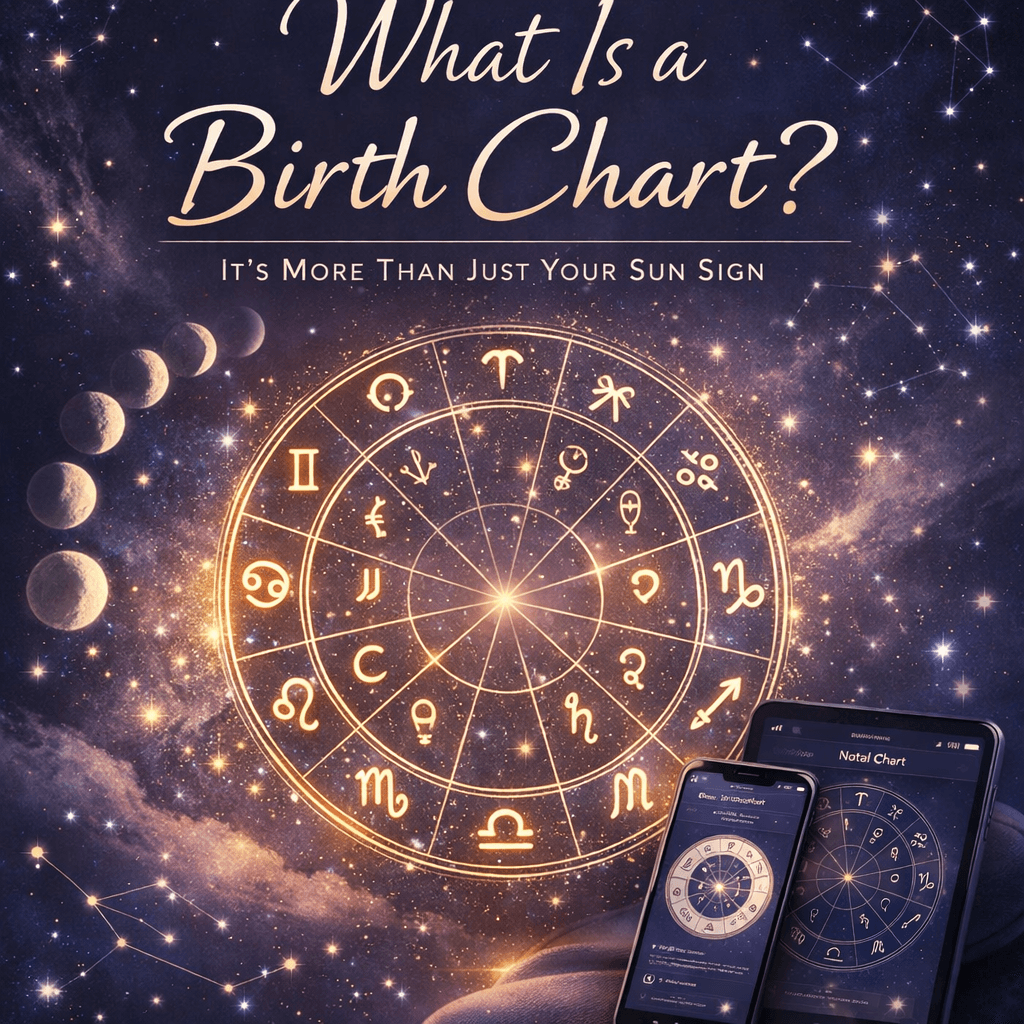
A full birth chart maps ten celestial bodies across twelve houses, producing dozens of placements and hundreds of possible aspects. The most important layers are:
The Big 3 — Sun, Moon, Rising. Your Sun sign describes your core identity and conscious drive. Your Moon sign describes your emotional wiring, your instinctive reactions, what you need to feel safe. Your Rising sign (also called the Ascendant) describes how you present to the world — the first impression you make and the lens through which you experience life. Two people with the same Sun sign but different Rising signs will move through the world in completely different ways.
The Personal Planets — Mercury, Venus, Mars. Mercury shows how you think, communicate, and process information. Venus shows how you love, what you find beautiful, and what you value in relationships. Mars shows what you chase, how you assert yourself, and where your drive lives. These three planets vary enough between people of the same sun sign to produce wildly different personalities.
The Social Planets — Jupiter and Saturn. Jupiter shows where you expand naturally, where luck tends to find you, and where you're inclined toward excess. Saturn shows where life applies the most pressure — your area of greatest challenge and, eventually, greatest mastery.
The 12 Houses. The houses divide the chart into twelve life areas: identity, money, communication, home, creativity, health, relationships, transformation, philosophy, career, community, and the unconscious. Which planets fall in which houses tells you where those planetary energies are expressed in your actual life.
The Aspects. Aspects are the angles between planets — conjunctions, squares, trines, oppositions, and more. They show which parts of your personality are in harmony and which are in tension. A Venus-Mars square, for instance, creates internal friction between how you love and how you pursue. A Sun-Jupiter trine suggests natural confidence and optimism. The aspects are where the chart becomes a story rather than a list.
Why Two People Born on the Same Day Have Different Charts
The planets move slowly enough that two people born on the same day share the same Sun, and usually the same Moon (unless they're born near a Moon sign change). But the Rising sign changes every two hours. That means the entire house structure of the chart shifts completely across a single day. Someone born at 6am has a completely different chart architecture than someone born at 6pm, even if they share the same birthday.
Birth time matters enormously. Without it, you can read the planetary placements but you can't cast accurate houses, and you can't know the Rising sign. If you don't know your exact birth time, it's worth checking your birth certificate — many countries record it. If you genuinely can't find it, a noon chart gives you the planetary positions with the house accuracy caveat noted.
What to Do With Your Chart
The first step is simply generating it. Once you have your placements in front of you, the picture tends to land in a way that generic horoscopes never do. Most people find that their Moon sign describes them more accurately than their Sun sign. Many find that their Rising sign is the one their friends would pick if asked to choose.
The deeper work is understanding how the placements interact — how your Saturn placement might explain a recurring pattern in your life, how your 7th house ruler might explain the type of partner you keep attracting, how your Nodal axis points to the direction your soul is oriented toward in this lifetime.
That's what makes a birth chart worth returning to rather than reading once and forgetting. It's not a personality test. It's a map.
→
Generate your free birth chart — enter your date, time, and place of birth to see your full chart with every placement explained.