Swami Horoscope
Blog
Guides March 3, 2026

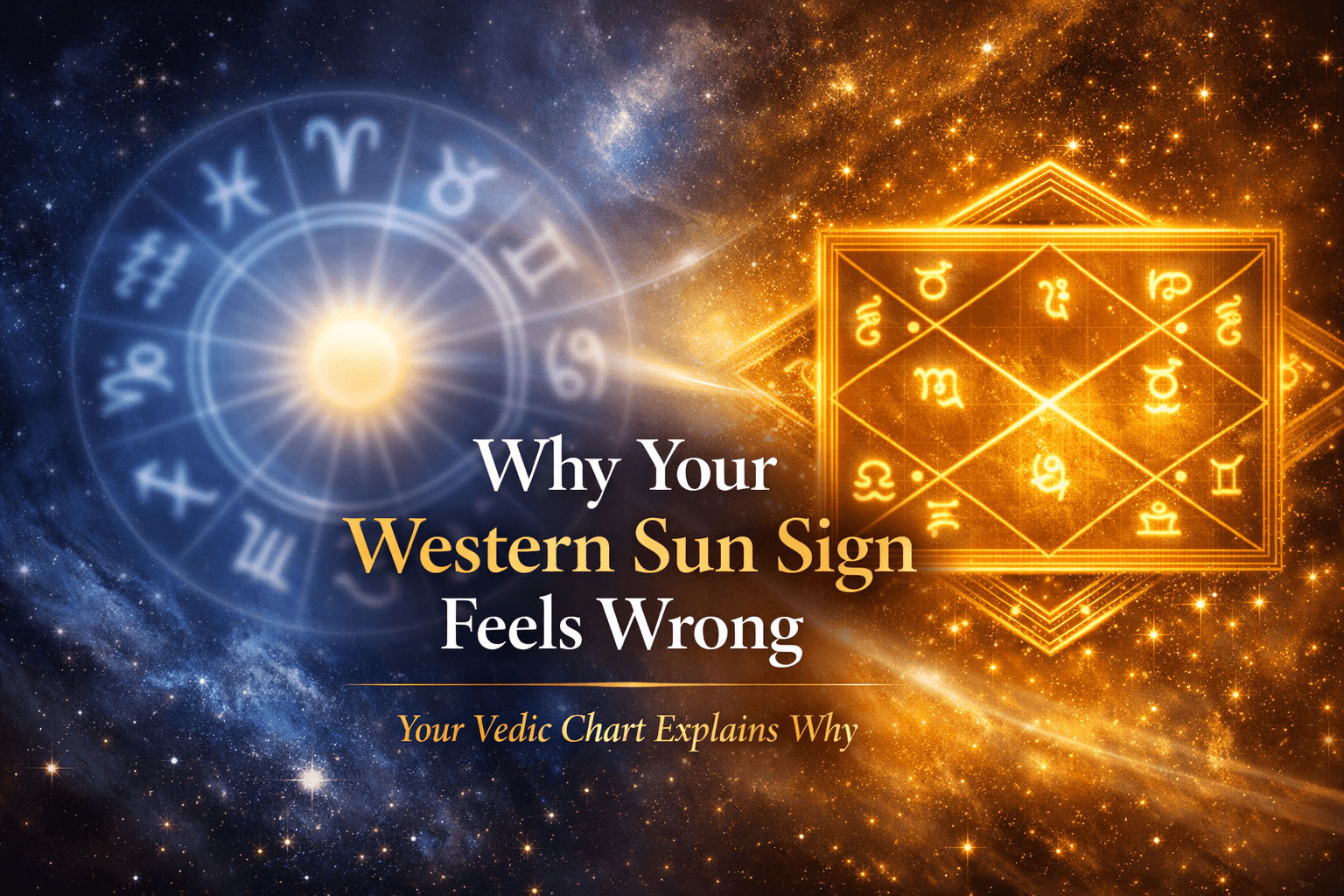
Why Your Western Sun Sign Feels Wrong (Your Vedic Chart Explains Why)

Have you ever read your horoscope and thought "that's not me at all"? You're not broken — your Vedic chart reveals the deeper truth your Western sun sign can't see. Discover why millions of people feel disconnected from their zodiac sign, and what the ancient Vedic system shows about who you really are.

Why Your Western Sun Sign Feels Wrong (Your Vedic Chart Explains Why)
You know your sun sign. Maybe you've known it since you were a teenager. You're a Scorpio, or a Leo, or a Virgo — and at first, it fit. But somewhere along the way, you started reading your horoscope and thinking: this doesn't sound like me at all. You're not alone. Millions of people every year quietly wonder why their zodiac sign feels like a costume that doesn't quite fit. And the answer isn't that astrology is wrong. The answer is that Western astrology is only showing you half the picture. Your Vedic birth chart shows the other half — and for many people, it's the half that finally makes sense.

The Reason Your Sign Might Feel Off

Western astrology and Vedic astrology both track the same planets. They both use the same 12 zodiac signs. But they measure the sky in fundamentally different ways — and that difference shifts your sun sign by roughly 23 degrees, which is enough to move most people into a completely different sign. Western astrology uses what's called the tropical zodiac. It anchors the zodiac to the seasons, not the stars. Aries always begins at the spring equinox, regardless of where the actual constellation of Aries sits in the sky. Vedic astrology uses the sidereal zodiac. It tracks the actual positions of the stars and planets as they appear in the sky right now. Because Earth wobbles on its axis over thousands of years — a phenomenon called the precession of the equinoxes — the tropical and sidereal zodiacs have drifted apart by about 23-24 degrees. What this means practically: if you're a Scorpio in Western astrology, your Vedic chart may show you as a Libra. If you're a Sagittarius, you might actually be a Scorpio in Vedic terms. Neither system is "wrong." They're measuring different things. But if you've only ever read one, you've only ever seen one side of yourself.

What the Western Sun Sign Actually Represents

In Western astrology, your sun sign describes your core identity, your ego, and your life force energy. It's the sign most people know — the one you find from your birthday. It speaks to who you're becoming, your conscious personality, the way you shine when you're at your best. Western astrology is excellent for understanding your psychology. It excels at describing:
  • Your conscious personality and ego expression
  • Your relationship patterns (especially through Venus and Mars)
  • Psychological depth through the outer planets
  • The archetypal story of your life
This is why Western astrology resonates so deeply in therapy-adjacent spaces, in personality exploration, and in relationship analysis. It speaks the language of the self.

What Your Vedic Chart Reveals That Western Astrology Can't

Vedic astrology — also called Jyotish, meaning "science of light" — is a 5,000-year-old system from ancient India. Where Western astrology focuses on the psychological self, Vedic astrology focuses on karma, dharma, and destiny. Your Vedic chart doesn't ask "who are you?" as much as it asks "why are you here, and what is your soul working through in this lifetime?" Key things your Vedic chart reveals that Western astrology doesn't:
  • Your Nakshatra — your lunar birth star, one of 27 ancient star clusters that gives a level of personality detail far beyond any sun sign
  • Your Dasha periods — a precise timing system that maps which planetary energies are active in your life right now, and when major life chapters will shift
  • Your Moon sign — in Vedic astrology, the Moon sign is considered even more important than the sun sign, because it governs your mind, emotions, and daily experience
  • Your karmic patterns — through the nodes of the moon (Rahu and Ketu), your chart shows what karma you're releasing and what soul lessons you're here to learn

Real Example: Why a Leo Might Feel Like a Cancer

Take someone born on August 10th. In Western astrology, they're a Leo — bold, creative, expressive, attention-seeking. But if they've always felt more introverted, emotionally sensitive, and home-oriented than the typical Leo description suggests, there's a reason. In Vedic astrology, August 10th falls in Cancer. Their Vedic sun sign is Cancer — nurturing, deeply feeling, intuitive, protective. And suddenly, the pieces fit. This doesn't invalidate their Western Leo placement. It adds to it. Their Western chart says: "You have the soul of a performer and a natural leader." Their Vedic chart says: "But your karmic foundation is rooted in emotional depth, family bonds, and intuitive wisdom." Together, the two charts tell a much richer story than either one alone.

The Most Common Reason People Feel Disconnected From Their Sign

There are actually several reasons people don't identify with their Western sun sign — and the Vedic shift is only one of them. 1. Your rising sign may be dominant. The ascendant (rising sign) is the mask you wear in the world, and many astrologers argue it's more visible in your personality than your sun sign. If your rising sign is very different from your sun, you may identify more with your rising. 2. Your moon sign shapes your daily experience. While your sun sign describes who you're becoming, your moon sign describes how you feel moment to moment. Introverted Scorpio sun people with an Aries moon often feel more Aries than Scorpio in daily life. 3. Stelliums pull your energy elsewhere. If you have three or more planets in a sign other than your sun sign, that sign's energy often dominates your personality. Someone with a Scorpio sun but four planets in Gemini may feel far more Gemini in character. 4. Your Vedic chart shows a different picture entirely. As discussed above, your Vedic sun, moon, and rising all shift — and the combination may align far more closely with who you actually experience yourself to be.

How to See Both Your Western and Vedic Charts Together

The most insightful thing you can do right now is run both charts side by side and see where they align and where they diverge. Most people find that one system describes their inner emotional world better, while the other describes their outer personality and life circumstances more accurately. When you read both together, you get the full picture: who you are (Western) and why you're here (Vedic). To get both charts at once — including your Western sun, moon, and rising alongside your Vedic placements and Nakshatra — run your free dual chart on Swami. It takes less than a minute and shows you both systems side by side, with plain-language interpretations of what your placements actually mean.

The Bottom Line

If your Western sun sign has never quite felt like you, it's not because astrology doesn't work. It's because you've only been reading half your story. Your Vedic chart holds the other half — the karmic blueprint, the soul's purpose, the timing of your life chapters, and the Nakshatra that describes you with a depth of detail most people have never encountered before. Both charts are true. Both are you. And reading them together is where astrology becomes genuinely useful rather than just entertaining. Ready to see who you really are? Get your free Western + Vedic birth chart on Swami →
Why Your Western Sun Sign Feels Wrong (Your Vedic Chart Explains Why) | Swami Horoscope